Poem of the Week, by D.R. Goodman

IMG_2137Last week I dreamed a dream so disturbing that I was afraid to google its meaning and asked the Painter to do so for me. The closest interpretation I can find says it’s about something you once dreamed of doing, he said. You want to reclaim something you’ve lost in yourself. 

The interpretation hit me hard. Thinking about it over the next few days, I kept remembering a late afternoon almost twenty years ago when I was wandering trail-less through a quiet forest. At one point I stopped and looked up and met the eyes of an owl looking back at me. This was the first time I had ever seen a living owl. I tilted my head to take it in, and the owl tilted its head the same way. Back and forth we went, observing each other. I don’t know exactly what that owl or this poem below –a poem I’ve held in my heart ever since I first read it–have to do with my terrible, galvanizing dream. But I intend to figure it out. 


Owls in the City Hills, by D.R. Goodman

how they hunt us,
casting their deep vowels like feathered hooks,
to pull us from shallow sleep or simple talk,
and out to the night, the stand of eucalyptus

a looming silhouette, the black above us;
we, barefoot on the littered deck, and blind,
stare wide into the dark and hear the sound
move eerily from tree to tree around us;

our backs to the spreading net of city lights
below, we’ve nothing but the trees, our eyes,
the dark, the sound, these owls we cannot see—

though once at dusk, by chance, I saw one light
and spread its wings, and tinged by copper skies,
lay silence to the city, utterly.
For more information on poet and martial arts expert D.R. Goodman, ​please click here.

Website

Blog

Facebook page

@alisonmcghee

Poem of the Week, by Louis Simpson

IMG_1960There was a time in my life when, if I saw a dark bird on my lawn staring at me, I worried that someone I loved was about to be hurt. Certain people around me believed in signs and superstitions and I, with porous borders, took on their fears. Living like that is exhausting, and one day, I decided to pay attention to my own radar instead.

But if you’ve gone a long time under the influence of others, it’s hard to reclaim faith in yourself. You have to relearn how to distinguish between false danger and real danger, which is sometimes invisible, like the time in my life when a place I lived in became filled with a menacing energy – I could feel it.

The choices were either move out or fight back. So I hauled the furniture outside and washed it with soap and water. Dragged the rugs out and beat them on the grass. Opened all the windows. Ran around from room to room and outside, waving my arms and yelling at the dark birds to get the hell out of there. It took an afternoon, but by sunset, the place was mine again. You have to fight the forces that want you crushed. When I read this poem below, I got goosebumps. 


The Hour of Feeling, by Louis Simpson

Love, now a universal birth,
        From heart to heart is stealing.
        From earth to man, from man to earth:
        —lt is the hour of feeling.
                Wordsworth

A woman speaks:
“I hear you were in San Francisco.
What did they tell you about me?”

She begins to tremble. I can hear the sound
her elbow made, rapping on wood.
It was something to see and to hear—
not like the words that pass for life,
things you read about in the papers.

People who read a deeper significance
into everything, every whisper…
who believe that a knife crossed with a fork
are a signal…by the sheer intensity
of their feeling leave an impression.

And with her, tangled in her hair,
came the atmosphere, four walls,
the avenues of the city
at twilight, the lights going on.

When I left I started to walk.
Once I stopped to look at a window
displaying ice skates and skis.
At another with Florsheim shoes…

Thanks to the emotion with which she spoke
I can see half of Manhattan,
the canyons and the avenues.

There are signs high in the air
above Times Square and the vicinity:
a sign for Schenley’s Whiskey,
for Admiral Television,
and a sign saying Milltag, whatever that means.

I can see over to Brooklyn and Jersey,
and beyond there are meadows,
and mountains and plains.

For more information on Louis Simpson, please click here.

Website

Blog

Facebook page

@alisonmcghee

Poem of the Week, by W.S. Merwin

Istanbul, D and pigeonsMy daughter and I were in Istanbul for a week, our first time in a country where the call to prayer sounded five times a day. I remember sitting by the window at sunset as the song of the muezzins rose in the air. It was beautiful and unearthly and I wanted to hold onto it so it would never end. It’s an almost panicky feeling, that wanting to hold on. Long ago, as a means of coping with it, I began to tell myself that You can always come back, Alison

In my heart, pigeons are still fluttering around my daughter on the cobblestones, and we are still wandering the shore of the Bosphorus, and we are both looking up, up, up at the dome of the Hagia Sophia. And then back, back, back I go in time, to the magical moment when she first opened her eyes. Every minute of being alive is its own first and last. You can’t go back.


Youth, by W.S. Merwin

Through all of youth I was looking for you
without knowing what I was looking for

or what to call you I think I did not
even know I was looking how would I

have known you when I saw you as I did
time after time when you appeared to me

as you did naked offering yourself
entirely at that moment and you let

me breathe you touch you taste you knowing
no more than I did and only when I

began to think of losing you did I
recognize you when you were already

part memory part distance remaining
mine in the ways that I learn to miss you

from what we cannot hold the stars are made


​For more information on WS Merwin, please ​read this.


Poem of the Week, by Dorianne Laux

IMG_2315The suicide of Alan Krueger last week, a man I didn’t know but whose work I admire, a man clearly beloved by so many, hit me hard. It brought me back to my early twenties, when the suicide of someone I loved both ended his life and permanently altered mine. Crying comes hard to me and does not bring relief, but it came anyway this week. At one point I found myself alone, apologizing out loud for things I wish I’d done differently.
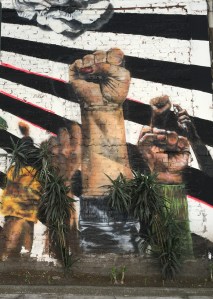
I’m haunted by the sense that the cruelty and hatred so on display these days made things worse for Alan Krueger. It makes things worse for everyone. The only thing I can do, like the poet below, is try to subvert it with kindness.

For the Sake of Strangers, by Dorianne Laux

No matter what the grief, its weight,
we are obliged to carry it.
We rise and gather momentum, the dull strength
that pushes us through crowds.
And then the young boy gives me directions
so avidly. A woman holds the glass door open,
waits patiently for my empty body to pass through.
All day it continues, each kindness
reaching toward another – a stranger
singing to no one as I pass on the path, trees
offering their blossoms, a retarded* child
who lifts his almond eyes and smiles.
Somehow they always find me, seem even
to be waiting, determined to keep me
from myself, from the thing that calls to me
as it must have once called to them –
this temptation to step off the edge
and fall weightless, away from the world.   


*Note that this poem was published in 1994, when this word was in common usage.

For more information on Dorianne Laux, please check out her website


Website

Blog

Facebook page

@alisonmcghee


IMG_2315

Poem of the Week, by Martin Espada

IMG_E2022One of the top-rated MFA programs in the country once recruited me to fly out and interview for a fiction position. A day into the interview, deep in discussion of teaching technique with the faculty and students, I subtly began to portray myself as less interested in criticism and more interested in nurturing a creative spark. This wasn’t what they wanted in a teacher and I knew it. I was in effect throwing the interview, but I wasn’t sure why. 
Years later, I do. In the midst of the enormous talent gathered in that interview room, I wanted to be back with my students. My immigrant, refugee, loan-burdened, first in their family to go to college, work two jobs and raise a family and still make it to class students. Listening as they read their work aloud, then clapping for their gargantuan effort. Seeing a poem they wrote make their classmates cry. When news broke last week of the college-admission bribery scandal, this stunning poem by Martin Espada instantly came to mind, and I thought of my students, their hands upturned and burning.


Who Burns for the Perfection of Paper
by Martin Espada

At sixteen, I worked after high school hours
at a printing plant
that manufactured legal pads:
Yellow paper
stacked seven feet high
and leaning
as I slipped cardboard
between the pages,
then brushed red glue
up and down the stack.
No gloves: fingertips required
for the perfection of paper,
smoothing the exact rectangle.
Sluggish by 9 PM, the hands
would slide along suddenly sharp paper,
and gather slits thinner than the crevices
of the skin, hidden.
The glue would sting,
hands oozing
till both palms burned
at the punch clock.

Ten years later, in law school,
I knew that every legal pad
was glued with the sting of hidden cuts,
that every open law book
was a pair of hands
upturned and burning.

For more information on Martin Espada, please check out his website.


Website

Blog

Facebook page

@alisonmcghee

Poem of the Week, by William Stafford

IMG_2323 A few days ago at sunset the sky was unearthly. The Painter came home, grabbed his camera and tripod and headed to the beach to take a bunch of photos. My internal, unspoken take on this, having never seen him take a sunset photo before: You had a frustrating day in the studio. Nothing was working with your paintings. You feel blocked, so you’re trying something new, to change up the energy and get things moving again. 
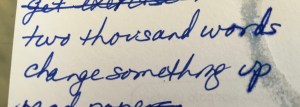
Talk of things like a muse, or writer’s block, makes me uneasy and impatient. But I deeply understand what it means to be stuck in a rut, retreading the same ground, unable to make something that feels wild and new when wild and new is what you crave. What the Painter was trying to do by varying his routine is what I’m trying to do when, on my daily list, I add “change something up.” It’s what William Stafford meant when he talked about the sunlight bending. It’s a kind of salvation that you have to search for and find, search for and find, your entire life long. 


When I Met My Muse, by William Stafford

I glanced at her and took my glasses
off–they were still singing.
They buzzed
like a locust on the coffee table and then
ceased.
Her voice belled forth, and the
sunlight bent.
I felt the ceiling arch, and
knew that nails up there took a new grip
on whatever they touched.
“I am your own
way of looking at things,” she said.
“When you allow me to live with you, every
glance at the world around you will be
a sort of salvation.”
And I took her hand.


For more information about William Stafford, please click here.


Website

Blog

Facebook page

@alisonmcghee

Poem of the Week, by Catherine Pierce

IMG_0531We were classmates. He was a country kid, like me, and like me, he was condemned to ride the bus for miles and miles. I dreaded that bus every day of my life –it was a place of fear and intimidation and endless cruelty.
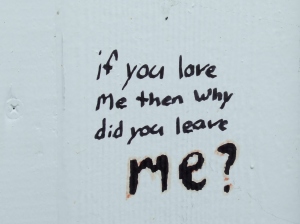
On this particular day, he sat down next to me and everyone began teasing us. They were loud and relentless. I was desperate to make them stop, make it stop, make it all stop just stop just stop, and at some point I picked up my empty lunch box and bashed it over his head. 

Did the teasing end? I don’t remember. What I do remember is how he held his hands up to protect himself. The poem below brought me back to those years of fear and that day on the bus. Kindness is in part an act of self-preservation. Had I just sat still and endured the ride I could have spared myself the lifelong memory of having hurt a kid like me, another kid who was only trying to get home. 


Poem for the Woods, by Catherine Pierce 
        

Not as I would dream them now, not with growls
and twig snaps, not with dark birds and thorned vines

I’ve invented (keening blackwing, violencia). Not late-dayblood-
sun-dappled, not refuge of men equipped

with knives and lust, not a mouth into which you might
venture and not return, no, nothing like that.

This is a poem for the woods as I knew them,
shaded and cool behind the Novaks’ house.

They seemed endless, but there was a shortcut
to Fairblue Swim Club. They held no growls,

no spikes. Only squirrels skittering, plunking acorns
down the canopy. We’d been warned of poison ivy,

but never found it. We’d been warned of rotten limbs,
but none fell. One muddy, sun-laced afternoon, we took salt

from the pantry and ventured out to where the rocks
teemed with slugs. I’d like to say our cruelty

had to do with power—human girls versus torpidity—
but really it was our curiosity, pure and unnuanced.

We wanted to see mineral against membrane.
We wanted to see something living melt. If I could,

I’d find my younger self in those woods and stop her.
I’d say, Someday you’ll carry your cruelties with you

and you’ll never be able to set them down. Keep walking now.
Keep pretending you know of nothing but kindness
.


For more information on Catherine Pierce, please check out her website.

Poem of the Week, by Adelia Prado

Photos 997My daughter at eight: What would happen if you die? I tell her she would be very sad but everyone would take such good care of her, and she says No, they wouldn’t. Because I would be dead too, of sadness. My son at four shuffles out of the bedroom in his first pair of flip-flops, having put them on himself with the strap between his second and third toes. It’s fine, mama, don’t worry, they don’t hurt, I can walk. My grandmother, flustered and red-faced in the small kitchen where she’s trying to make dinner for me: Oh Alison, I’m just no use at all anymore. Me outwardly protesting but inwardly stricken by the knowledge that in that single instant, everything is now changed.  
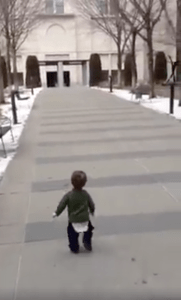
“Because living is just too much!” I always say when someone in an audience asks why I became a writer. “It’s all too hard! I’d lose my mind if I didn’t turn it into books!” 

I laugh and they laugh, but do they know I’m not joking? Writing makes it possible for me to live in a world without my grandmother in it, a world where my heart beats outside my body in the form of my children, where every new day brings a thousand possibilities and a thousand losses. Writing is my way of cheating time.


The Mystical Rose, by Adelia Prado

The first time
I became conscious of form,
I said to my mother:
“Dona Armanda has a basket in her kitchen
where she keeps tomatoes and onions”
and began fretting that even lovely things
eventually spoil,
until one day I wrote:
“It was here in this room that my father died,
here that he wound the clock
and rested his elbows
on what he thought was the windowsill
but was the threshold of death.”
I understood that words grouped like that
made it possible to live without
the things they describe,
that my father was returning, indestructible.
It was as if someone had painted a picture
of Dona Armanda’s basket and said:
“Now you can eat the fruit.”
So, there is order in the world!
—where does it come from?
And why does order, which is joy itself,
and bathes in a different light
than the light of day,
make the soul sad?
We must protect the world from time’s corrosion,
cheat time itself.
And so I kept writing: “My father died in this room…
Night, you can come on down,
your blackness can’t erase this memory.”
That was my first poem.    


​For more information on Adelia Prado, please follow this link.​

Website

Blog

Facebook page

@alisonmcghee

Poem of the Week, by Adam Tavel

Screen Shot 2019-02-16 at 10.16.17 AMMy five year old nephew is currently huddled behind closed doors inside his family’s new freestanding pantry, where he fits neatly into the bottom cupboard. I know this because my brother texts me ongoing updates as to this fixation with the pantry, along with the fact that my nephew just declared he’s no longer a ninja genius but a secret agent. (Didn’t surprise me at all. I never bought the ninja genius line.) My nephew cracks me up and breaks my heart the way all little kids, over and over, break my heart.
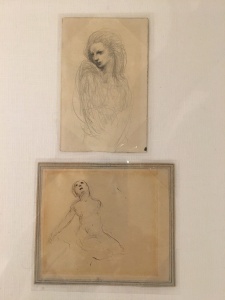
The poem below makes me want to put my arms around every little kid in the world – the solemn-eyed children at the schools I visit, the cardboard sword-wielding child in this poem, my secret agent nephew, and every single one of the migrant children I keep seeing in photos, crying at the border. Maybe they don’t know how tiny they are. Maybe we don’t know how strong they are. 


Halloween Vespers with Homemade Vader, by Adam Tavel 
        

Bless the amber porch light that coronets
his flimsy helmet’s sheen and the ringlets
this dusk breeze bounces on elastic
straps, thin as earthworms baked black
atop the stoop. Bless the dragging cape
I forgot to hem that brooms its scrape
of maple leaves trailing down beyond
the sidewalk to a dozen murky ponds
pocking our gravel drive with day-old rain.
Bless this Sith Lord’s right glove stained
with juice — it transubstantiates to blood
from rebel galaxies that fought the flood
of clones who stomped peasant martyrs free
of blasters, cause, and zealotry.
Bless the cardboard saber crayoned red
that hums its slash through Wookiee dread,
each Tusken Raider’s door we dash
to swell our bucket’s mounting stash
before we tramp across another lawn.
Bless the mask that slides for coughs and yawns.
Bless the snacking boy who curses Jedi scum,
this son who cleaves my hand and calls me son.


For more information about ​Adam Tavel, please click here.

Poem of the Week, by Gibran Kahlil Gibran

IMG_2158In the lobby of the Minnesota Public Radio headquarters are three white egg-shaped chairs. Whenever I’m there I crawl into one of them, sit cross-legged, and close my eyes. Sitting in one is like wearing a warm sweatshirt with the hood pulled entirely over your head. My love for those chairs is inordinate. When I picture a safe place to comfort myself when sad or troubled, those egg-shaped chairs come to mind. 

When I was a little girl, the poems in The Prophet, by Kahlil Gibran, used to bring me the same kind of solace. A few days ago I stood in a museum in Mexico City admiring some beautiful paintings by an artist named Gibran Kahlil Gibran, the similarity of whose name to the poet made me happy. A display case was filled with handwritten letters by the artist and I read each one out loud to myself. The fact that the painter wondered about the same things I do, love and longing and sadness, was as inexpressibly comforting to me as the egg-shaped chairs. It turns out that the painter and my poet are the same man. His words from a hundred years ago, found in an unfamiliar museum in an unfamiliar city in a country not my own, go straight to my heart.


Found poem, by Gibran Kahlil Gibran (lines from his handwritten letters, arranged by Alison McGhee)

Are you unhappy, my beloved?
I, too, am unhappy sometimes.
There are days when
bitterness mingles itself with life—
days when my dreams are
dreams of hunger and
my songs are sighs, and the
things I try to create are
sad, so very sad.

And there are days when I
want to be nothing but a
shepherd somewhere on a
faraway mountain, or an
unthought-of brother in an
unknown convent, or an
outcast on a lonely,
undiscovered island.

I have journeyed twenty-five
times around the sun—and
do not know how
many times the moon has
sailed around me—and I have
not solved the
mystery of light yet.

For more information about the painter and poet Gibran Kahlil Gibran, please click here.​