
I used to define “sexual assault” in my own head as rape. So, in my own definition, I had never been sexually assaulted. Then I woke up, and took a casual glance back at my life: 1) Fifth grade, waiting with my class to go back in after recess, a classmate reached out in front of everyone and twisted my breast bud as hard as he could. The shock and physical pain were so severe that I almost vomited. I still think about this pretty much every day. 2) In high school, the jocks lined up on both sides of the hallway to rate the girls on a scale of 1-10 as we walked in. 3) At age sixteen, as an exchange student in Portugal on a sardine-can-crowded bus, a man pushed himself against me, ran his fingers up under my skirt and shoved them inside me, all the while laughing and rubbing his face against mine. 4) In college one winter, there were rumors of multiple rapes on campus, never publicized by campus authorities, which had us all uneasy. My solution was to wear a long coat, hulk up my shoulders and stride across campus if I had to be out at night, so that I would be perceived as a strong man. 5) Also in college, a male friend would corner me when he got drunk and grope me while pinning me against the wall with his knee and telling me he couldn’t help himself because I was just so hot. 6) Age 23, I went on a date with a man who yanked my underwear down and from whom I ran away, to find out the next morning that he had preemptively gaslighted me by telling others that it was clear I had very little experience with men and was, sadly, a tease. These are a few small incidents out of a lifetime of incidents, almost all of which I’ve left out, including the masturbating perves. My experiences are completely run of the mill and common to all my women friends. I’m still grateful that I haven’t been violently raped, and I am sad that I just used the word “grateful” and that I actually feel that way.
Rape Joke
– Patricia Lockwood
The rape joke is that you were 19 years old.
The rape joke is that he was your boyfriend.
The rape joke it wore a goatee. A goatee.
Imagine the rape joke looking in the mirror, perfectly reflecting back itself, and grooming itself to look more like a rape joke. “Ahhhh,” it thinks. “Yes. A goatee.”
No offense.
The rape joke is that he was seven years older. The rape joke is that you had known him for years, since you were too young to be interesting to him. You liked that use of the word interesting, as if you were a piece of knowledge that someone could be desperate to acquire, to assimilate, and to spit back out in different form through his goateed mouth.
Then suddenly you were older, but not very old at all.
The rape joke is that you had been drinking wine coolers. Wine coolers! Who drinks wine coolers? People who get raped, according to the rape joke.
The rape joke is he was a bouncer, and kept people out for a living.
Not you!
The rape joke is that he carried a knife, and would show it to you, and would turn it over and over in his hands as if it were a book.
He wasn’t threatening you, you understood. He just really liked his knife.
The rape joke is he once almost murdered a dude by throwing him through a plate-glass window. The next day he told you and he was trembling, which you took as evidence of his sensitivity.
How can a piece of knowledge be stupid? But of course you were so stupid.
The rape joke is that sometimes he would tell you you were going on a date and then take you over to his best friend Peewee’s house and make you watch wrestling while they all got high.
The rape joke is that his best friend was named Peewee.
OK, the rape joke is that he worshiped The Rock.
Like the dude was completely in love with The Rock. He thought it was so great what he could do with his eyebrow.
The rape joke is he called wrestling “a soap opera for men.” Men love drama too, he assured you.
The rape joke is that his bookshelf was just a row of paperbacks about serial killers. You mistook this for an interest in history, and laboring under this misapprehension you once gave him a copy of Günter Grass’s My Century, which he never even tried to read.
It gets funnier.
The rape joke is that he kept a diary. I wonder if he wrote about the rape in it.
The rape joke is that you read it once, and he talked about another girl. He called her Miss Geography, and said “he didn’t have those urges when he looked at her anymore,” not since he met you. Close call, Miss Geography!
The rape joke is that he was your father’s high-school student — your father taught World Religion. You helped him clean out his classroom at the end of the year, and he let you take home the most beat-up textbooks.
The rape joke is that he knew you when you were 12 years old. He once helped your family move two states over, and you drove from Cincinnati to St. Louis with him, all by yourselves, and he was kind to you, and you talked the whole way. He had chaw in his mouth the entire time, and you told him he was disgusting and he laughed, and spat the juice through his goatee into a Mountain Dew bottle.
The rape joke is that come on, you should have seen it coming. This rape joke is practically writing itself.
The rape joke is that you were facedown. The rape joke is you were wearing a pretty green necklace that your sister had made for you. Later you cut that necklace up. The mattress felt a specific way, and your mouth felt a specific way open against it, as if you were speaking, but you know you were not. As if your mouth were open ten years into the future, reciting a poem called Rape Joke.
The rape joke is that time is different, becomes more horrible and more habitable, and accommodates your need to go deeper into it.
Just like the body, which more than a concrete form is a capacity.
You know the body of time is elastic, can take almost anything you give it, and heals quickly.
The rape joke is that of course there was blood, which in human beings is so close to the surface.
The rape joke is you went home like nothing happened, and laughed about it the next day and the day after that, and when you told people you laughed, and that was the rape joke.
It was a year before you told your parents, because he was like a son to them. The rape joke is that when you told your father, he made the sign of the cross over you and said, “I absolve you of your sins, in the name of the Father, and of the Son, and of the Holy Spirit,” which even in its total wrongheadedness, was so completely sweet.
The rape joke is that you were crazy for the next five years, and had to move cities, and had to move states, and whole days went down into the sinkhole of thinking about why it happened. Like you went to look at your backyard and suddenly it wasn’t there, and you were looking down into the center of the earth, which played the same red event perpetually.
The rape joke is that after a while you weren’t crazy anymore, but close call, Miss Geography.
The rape joke is that for the next five years all you did was write, and never about yourself, about anything else, about apples on the tree, about islands, dead poets and the worms that aerated them, and there was no warm body in what you wrote, it was elsewhere.
The rape joke is that this is finally artless. The rape joke is that you do not write artlessly.
The rape joke is if you write a poem called Rape Joke, you’re asking for it to become the only thing people remember about you.
The rape joke is that you asked why he did it. The rape joke is he said he didn’t know, like what else would a rape joke say? The rape joke said YOU were the one who was drunk, and the rape joke said you remembered it wrong, which made you laugh out loud for one long split-open second. The wine coolers weren’t Bartles & Jaymes, but it would be funnier for the rape joke if they were. It was some pussy flavor, like Passionate Mango or Destroyed Strawberry, which you drank down without question and trustingly in the heart of Cincinnati Ohio.
Can rape jokes be funny at all, is the question.
Can any part of the rape joke be funny. The part where it ends — haha, just kidding! Though you did dream of killing the rape joke for years, spilling all of its blood out, and telling it that way.
The rape joke cries out for the right to be told.
The rape joke is that this is just how it happened.
The rape joke is that the next day he gave you Pet Sounds. No really. Pet Sounds. He said he was sorry and then he gave you Pet Sounds. Come on, that’s a little bit funny.
Admit it.
For more information about Patricia Lockwood, please click here.
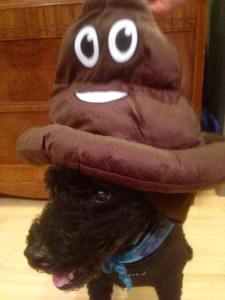 My dog is sleeping on the couch right now. We can read each other’s minds; before I get up from this table in a few minutes to go for a run, he will already have jumped down and trotted over to me, knowing I’m about to leave. When I return, he will be waiting at the door to greet me. He doesn’t wake up disturbed like me at the daily news, which even though I don’t watch television and I avoid certain headlines, I know anyway. It’s in the air, in the invisible waves that connect us to each other and the world. It’s a battle not to give in to the disgust and despair and cynicism and snark that sometimes feels omnipresent and, weirdly, more socially acceptable than hope. Hope is harder, and so is the steadfast work that makes things better. The dog in this beautiful poem reminds me of my own dog. Not everything is bad, he says, in action if not words.
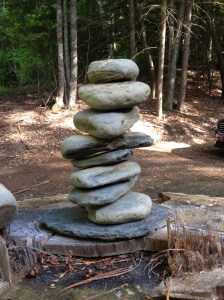 This poem makes me think of my mother and father, who, from my vantage point, seem to spend most of their time doing good things for others. Need sixty pounds of stuffing for the Octoberfeast? Sure. Need a ride to your dentist appointment sixty miles away? No problem. All-day help in the homeless shelter kitchen every third Wednesday? Of course. A listening ear in a time of sadness? They are there. They are there, they are there, they are there. Some people write checks and then there are the people like my parents, who wade in knee deep to fill the plates and then wash the plates, brew the coffee and then pour the coffee, welcome the new babies, slip a $20 in their graduation cards eighteen years later, and stand in line in dark clothes to say goodbye when the time comes. We are all headed to the same place; may as well name it Jerusalem, or Mecca, or the meaning-of-a-life-whatever-that-may-be, and make those steps count.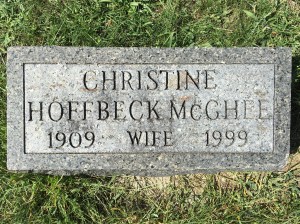
 When I was eighteen I left the landscape of my childhood –the foothills of the southwestern Adirondacks, in far upstate New York– for college in Vermont, and in all the years since I have never spent more than a week at a time in my homeland, always to visit my parents. You would think I left that world behind, the day I got to college, and in a way that’s true. The horizons of my life blew wide open that day, and they have kept right on opening. But every adult novel I’ve ever written is set in that land, with its maples and oaks that turn to flame in the autumn, pine trees in winter that look black against deep snow that looks blue or white or pink, depending. The people in those novels aren’t real, I conjured them up out of my heart and my head, but I wish they had been around when I was a girl. Maybe I would’ve loved them, maybe they would’ve loved me. When Alan Gillis in this beautiful, dreamlike poem below talks about the girl who sheds the skin of her longing only to escape into more longing, I know in my bones what he means. I guess everyone does.
 Walking Man was someone I first noticed many years ago because he walked as fast as me (apparently I walk with great purpose), and he seemed to walk all day long, every day of the year, tromping the lakes and streets of our southwest Minneapolis neighborhood. He was a strong, well-built, handsome man. In summer he wore shorts and a t-shirt, in winter jeans and a parka. One time only has Walking Man returned my hello; his eyes are usually fixed on a far horizon. Once, about fifteen years in, I passed a man sitting on a bench on Lake Calhoun and did a double-take. Was that Walking Man? Sitting? Yes. The first time I ever saw him not in motion. Two days ago an old man in jeans and a t-shirt came toward me on Lake Street: extreme bowlegs, a mane of flowing white hair, a rocking gait that hurt to witness, so painful did it look. I watched that old man lurch toward me, hoped he didn’t have far to walk, wondered if I could help. Then I realized who it was.
 I’m teaching a Creative Writing Boot Camp this week. Six days in a row, seven hours a day, nineteen of us gather in a windowed classroom halfway between Minneapolis and St. Paul to write and write and talk and talk about the art and craft and act of writing. Poems and tiny short stories, tiny memoirs. Beautiful, painful, funny, wistful fragments of life, captured on paper and released into the invisible air of the room. I could teach for another fifty years and never lose this astonishment, that nurses and truck drivers and musicians and stay at home parents and hair stylists and sex workers and clerks and commodities traders and group home workers, Muslim and Christian and atheist, come together in a single small room and transform themselves and me and the whole outside world by the power of sharing stories. If a teacher asked me to name a sacred place, the classroom would be mine.
 Alison McGhee