Poem of the Week, by Lisel Mueller

IMG_2176Once, when he was about eight, my son looked up at me and said, “Mama, what if we’re all characters in a book, and someone is writing us right now?”

Once, before the scale at the Y was digital, I stepped on it ready to maneuver the sliding weights, only to find that the unknown woman who had stood on it before me weighed, to the ounce, exactly as much as me. 

Somehow those two memories are connected, and somehow the poem below brings them back to me. I don’t understand why we are here in the world, or what the meaning of our lives is. I don’t understand why life is so unfair. Sometimes I wonder if there is a shadow Alison in a nearby, invisible world, living an alternate Alison life, and if she has the answers I don’t. 


In November, by Lisel Mueller

Outside the house the wind is howling 
and the trees are creaking horribly. 
This is an old story 
with its old beginning, 
as I lay me down to sleep. 
But when I wake up, sunlight 
has taken over the room. 
You have already made the coffee 
and the radio brings us music 
from a confident age. In the paper 
bad news is set in distant places. 
Whatever was bound to happen 
in my story did not happen. 
But I know there are rules that cannot be broken. 
Perhaps a name was changed. 
A small mistake. Perhaps 
a woman I do not know 
is facing the day with the heavy heart 
that, by all rights, should have been mine.


For more information about Lisel Mueller, please click here.

My websiteMy blogMy Facebook page.
Twitter and Instagram: @alisonmcgheewriter 

Poem of the Week, by Gerard Manley Hopkins

img_3440How I first found this poem is lost to me –was it in one of my grandmother’s huge and heavy high school English anthologies?–but it stunned me. I remember laboriously copying it word by word, line by line, complete with the strange little marks I would later learn were scansion, into my diary. 
What the poem was about I couldn’t have told you when I was a child, but I knew that the poet, dead long before I was born, had reached into the future and written it for me. In the same intuitive way I understood the made-up words wanwood and leafmeal, I knew the Margaret of the poem was me. The sorrow and longing that welled up from the first sentence to the last were in me then and they are in me still. At age nine this poem explained something deep and true and achingly beautiful about the world, something I already knew in my bones, and I knew it would be the poem of my life.


Spring and Fall, by Gerard Manley Hopkins

to a young child

Margaret, are you grieving
over Goldengrove unleaving?
Leaves, like the things of man, you
with your fresh thoughts care for, can you?
Ah! as the heart grows older
it will come to such sights colder
by and by, nor spare a sigh
though worlds of wanwood leafmeal lie;
and yet you will weep and know why.
Now no matter, child, the name:
sorrow’s springs are the same.
Nor mouth had, no nor mind, expressed
what heart heard of, ghost guessed;
It is the blight man was born for,
It is Margaret you mourn for. 


For more information on Gerard Manley Hopkins, please click here.

Website

Blog

Facebook page

@alisonmcghee

Poem of the Week, by Alison Luterman

WesternThe summer I turned nineteen I took the bus west to Wisconsin, to work at a mom and pop resort where the owners housed us in a firetrap and fed us leavings from the guests’ plates. After the second bout of food poisoning –through which we worked between dashes to the bathroom–my friend Polly and I quit.

Before dawn we snuck into the resort kitchen, loaded up on rolls and butter and apples, and waited, laughing, in the dark for the Greyhound, then jumped on board, still laughing.We had a layover in Chicago and we took ourselves and our duffels out to dinner at The Berghoff, spending most of the little bit we had earned that summer. The waiters flirted with us and we flirted back.

We were free, we were free, we were free. Now I know you can hold a moment of freedom in your heart your whole life long. My love affair with the west began that summer in Montana. Wide-open streets, the snow-capped Rockies, how it felt to laugh and jump naked late at night into the shockingly cold water of Flathead Lake.


Canoe, by Alison Luterman

When I was young, years ago, canoeing on the green
Green River, with my young first husband,

I wriggled out of my shorts, eased over the lip
of our little boat, and became eel-woman,

naked and glistening, borne along in the current.
He paddled, I floated and spun,

and let the ripples take me.
Even an hour of that kind of freedom

can last for years and years,
can become a touchstone you return to

long after the rented canoe has been returned,
and the road trip has ended, and then the marriage,

and then the husband’s brief life, and you yourself
have become someone else entirely; still

you return in your mind to the days
you could set up a tent in the dark,

and build a small fire
from birch bark and newspaper

and sit beside it, sipping tea, savoring your muscles’ sweet ache,
as one by one the uncountable stars came out.


For more information about Alison Luterman, please check out her website.

Poem of the Week, by Derek Walcott

IMG_0342People who say they have “no regrets” mystify me. Regrets, oh I’ve got a few. Like last night when I couldn’t get back to sleep for thinking about the times I yelled at my children when they were little. This didn’t happen much, but every time it did, my self-hatred was huge. It still is. As a mother I wanted always and only to be a comfort to my kids. But when you’re yelling, you’re not a comfort, are you?

In the dark hours before dawn, in hopes of forgiving myself by understanding myself, I tried to see myself as the little girl I used to be, the child who, like all children, had little control over her own life. No dice.

This morning I wrote notes to my children, telling them how sorry I was for having yelled. Because what else can I do? You can’t go back in time and undo things. Then my favorite line from this beautiful poem —give back your heart to itself–drifted into my head. 


Love After Love, by Derek Walcott

The time will come
when, with elation
you will greet yourself arriving
at your own door, in your own mirror
and each will smile at the other’s welcome,

and say, sit here. Eat.
You will love again the stranger who was your self.
Give wine. Give bread. Give back your heart
to itself, to the stranger who has loved you

all your life, whom you ignored
for another, who knows you by heart.
Take down the love letters from the bookshelf,

the photographs, the desperate notes,
peel your own image from the mirror.
Sit. Feast on your life.

For more information about Derek Walcott, please click here.

Poem of the Week, by Paul Hostovsky

IMG_1937

A beloved friend I lost touch with many years ago has been on my mind lately, so I googled him. My guess was he’d be out there somewhere, invisibly changing the world with his brilliance at math, and I was right.

In our early twenties my friend gave me a small book titled Innumeracy, about how statistics influence every aspect of our lives. One chapter detailed how every breath we take contains a minimum of three molecules of air breathed by every person who has ever been alive.

The knowledge that we will always be part of each other changed the way I think, and live, and write. Those we love and those we don’t,  those who love us and those who don’t – like it or not, we are connected forever. This beautiful poem makes me want to put my arms around the whole world and hold it tight. 


History of Love, by Paul Hostovsky

Because he loves the way she has
of touching him
and because she loves the way he has
of loving her
each has learned the other’s
way and the other’s touch
so when love turns
and the world turns
and the lovers turn from each other and go
to other lovers they take
they take all they know
of love and of touch
and they give it to another
and in this way love grows rich
and wise and wide among us
and in this way we are also
loving those who will come after
and those who came before
we ever came to love


For more information about Paul Hostovsky, please check out his website.

Poem of the Week, by Tess Gallagher

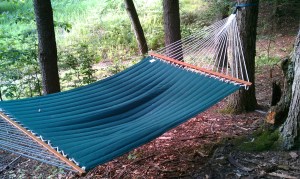
Shack, view straight up from the hammockYears ago I bought some raw land on a slope in Vermont. Hired someone to grade a tiny cleared patch in the woods. Drilled a well. Bought a one-room cabin kit off eBay and hired a carpenter to put it together. Spent many days and nights staring up from the porch and the hammock at the enormously tall pines pictured to the right.

The cabin was a seasonal place but even in summer it was always dark and cool. After some years I craved sunlight, so I asked a lumberjack friend if he would cut down a few of the pines. He said yes, if he could do it in the middle of winter. I don’t like to cut down trees, he said, even though he was a lumberjack. And I only do it in winter, when all the birds have left the nests.

When I read this poem I thought of him, my lumberjack friend who snowshoed alone up the unplowed dirt road to the cabin in February, towing his chainsaw and axe on a toboggan behind him, and went to work in the frozen stillness so he wouldn’t hurt the birds. 


Choices, by Tess Gallagher

I go to the mountain side
of the house to cut saplings,
and clear a view to snow
on the mountain. But when I look up,
saw in hand, I see a nest clutched in
the uppermost branches.
I don’t cut that one.
I don’t cut the others either.
Suddenly, in every tree,   
an unseen nest
where a mountain   
would be.  

                              for Drago Štambuk


​For more information on Tess Gallagher, please ​click here.

Website

Blog

Facebook page

@alisonmcghee

Poem of the Week, by Gregory Orr

IMG_4207Certain moments are burned into your brain and heart, moments that even as they happened you knew would haunt you forever, like the way your little boy nodded and kept nodding, that one afternoon on the couch. Looking back now, through the tunnel of time, there are passages so rough that you narrowed time down to half-hour segments in order to make it through. Had to trust that somehow the invisible ship would carry you from one invisible shore and deposit you on another. That you would find yourself again.

You do find yourself again, over and over, but you’re not the same person you were before. Each time, there has been a long season of necessary silence, and even if you look the same, you aren’t. Maybe we don’t heal so much as shift, and yield, and absorb in a way that lets us keep living with all the everythings that happen in a life.  


Aftermath Sonnet, by Gregory Orr

Letting my tongue sleep, 
and my heart go numb.

Sensing that speech
too soon,
after such a wound,
would only be
a different bleeding.

Even needing to leave
the page blank.
Long season
of silence—
trusting that under

its bandage of snow,
the field of me is healing.


For more information about Gregory Orr, please click here​.​

Website

Blog

Facebook page

@alisonmcghee


For more information about Gregory Orr, please https://www.poetryfoundation.org/poets/gregory-orr.


Poem of the Week, by Wendy Chin-Tanner

Screen Shot 2019-02-16 at 10.16.17 AMIn my 1000 Words class you could write anything you wanted –poem, essay, memoir, story, children’s book–as long as it was fewer than one thousand words. Does it sound easier to write short than long? It’s not. You have to take an image, a dream, a thought, a burning wish, and hone and pare it until there’s not an extra word.

This process of distilling words is my great love and my great challenge in everything I write. When I read the poem below –twelve short words that encompass the un-beginning of an entire life–I was spellbound.


Infertility, by Wendy Chin

You end me
like a period

ends a sentence
ends a line. 


For more information about Wendy Chin-Tanner, please click here.

Website

Blog

Facebook page

@alisonmcghee

Portrait of a Writer: Rene Denfeld

Screen Shot 2019-10-29 at 7.42.25 AMBoiling a work of art down to a few lines feels like an impossible task to me, which is why I dreaded writing book reports as a child (pre-internet, I got around it by writing book reports about imaginary books I dreamed up in my own mind). This is why I avoid book jackets, movie trailers, and podcast episode descriptions in favor of plunging in and figuring it out as I go.

This back-your-way-into-it method is how I first became aware of the writer Rene Denfeld on the This Is Actually Happening podcast. This Is Actually Happening is an unusual podcast in which the grave-voiced narrator, Whit Misseldine, edits himself entirely out of each episode. All you hear is the voice of the person being interviewed. You can sense when a question has been asked and then erased, but the result is a steady, unbroken hour-long stream of a single voice talking about their past, their present, how they got from where they were to where they are. It’s an hypnotic, unsettling way to present a human being.

On this particular episode, per usual, I didn’t know the featured interviewee. She mesmerized me, though. She spoke about her childhood, in which she was sexually and emotionally abused, recounting the events with a deep calm –her mother’s boyfriend, whom she loved, gradually deepened into a horror–and her even, conversational tone never altered. She ran away from home as a teenager and lived on the streets. She told the truth about what had happened to her. By the end of her recounting, the storyteller was middle-aged, her ties to her beloved younger sister had been lost, and the abuser was in prison. You could hear the sadness of that loss, and her love for her sister, and also her mother in her voice. Screen Shot 2019-10-29 at 7.46.36 AM

When she made it out of the brokenness of her early life and turned herself into a strong, grounded woman, she became a foster mother to children who also came from traumatized childhoods, eventually adopting three of them. Her voice slowed, turned tender and low, as she spoke of her children. She would be one hell of a mother, I thought as I listened. She spoke of how mothering children from foster care, no matter how challenging it was at times, was a lesson in the constancy of love and the resilience of both mother and children. 

“If I gave up on them, I would be giving up on myself,” she said at one point, and I felt in my own body how being the mother she wished she’d had helped her own childhood pain. At this point something in me rang a bell, a memory of having read this Modern Love essay a couple of years ago about a woman who fostered-to-adopted her children. Could it be the same writer?

Both her voice and her recounting of her life were calm and thoughtful. But there was something else about her that charmed me: her profound kindness in the face of true horror, abuse, and evil. It felt to me that this kindness was the result of a decision on the part of the speaker not to give in to bitterness, to hatred, but to walk toward love and light instead.

Screen Shot 2019-10-29 at 7.37.58 AMFinally, at the very end of the podcast, the narrator came back on to say that we had been listening to “Rene Denfeld, internationally best-selling novelist and public defense investigator.” I looked her up immediately. A public investigator for a public defender’s office, she has won multiple awards for her justice work with victims and the wrongly accused, including a 2017 Hero Award from the New York Times.

I bought her novel The Child Finder and read it in two days (warp speed for me). The star of the book, Naomi, is a young woman who specializes in finding missing, lost, stolen and trafficked children. The book is set in the mountainous depths of an Oregon winter, and Naomi slowly, with intuition and experience, tracks down a missing child and her captor. As I read, I heard Rene’s voice from the podcast reading to me. Echoes of her own life story were everywhere: in Naomi’s own lost childhood and the abuse she had suffered, in her determination to save the children she could, in the profound empathy, compassion, and understanding she shows even the captor.

It was another six months before her new novel, The Butterfly Girl, was published. I walked to Magers & Quinn the day it came out and bought it. Took it home and read it. This book, too, stars Naomi the child finder, but this time she is searching for the sister she left behind twenty years earlier. The book is in large part the stories of the “street kids” Naomi encounters in the gritty neighborhoods of Portland, Oregon, how they look out for each other and understand each other when no one else will take the time.

Despite the pain and suffering experienced by the children in her novels, Denfeld imbues the books with hope and an implicit faith that if you work toward a better reality, you can make it happen. In this, the novel is like its creator. These are dark times in our country and in the world. When my faith in goodness needs to be shored up, and I need reminding that steady work toward a better world will make it happen, Rene Denfeld is one of the heroes I turn to, both her life and her work. Beautiful human, beautiful writer.

Poem of the Week, by Gerald Stern

IMG_4897Last week I tucked myself behind a long black semi, far enough back so he could see me and my rattletrap moving truck in his big side mirrors. I do this sometimes on the highway when I’m tired or troubled or just want someone else to take over a little of the decision-making. Truckers (with a few exceptions) are the best drivers out there. They have to be. 

After a while, the trucker realized I was following him. In construction zones, he’d slow down a little once we were through, so that I could catch up to him. I was hungry and I had to pee but I didn’t want to lose my trucker, so I kept going. More than two hundred miles in, he put on his blinker for the next exit. Damn. So sad to see him go, sad, somehow, to think I’d never see him again. But he’d gotten me within fifty miles of home. I sped up at the exit ramp to say goodbye, and there he was in the window, smiling down at me, with a thumbs-up and a wave. 


Waving Good-Bye, by Gerald Stern

I wanted to know what it was like before we
had voices and before we had bare fingers and before we
had minds to move us through our actions
and tears to help us over our feelings,
so I drove my daughter through the snow to meet her friend
and filled her car with suitcases and hugged her
as an animal would, pressing my forehead against her,
walking in circles, moaning, touching her cheek,
and turned my head after them as an animal would,
watching helplessly as they drove over the ruts,
her smiling face and her small hand just visible
over the giant pillows and coat hangers
as they made their turn into the empty highway.


For more information on Gerald Stern, please click here.

Website

Blog

Facebook page

@alisonmcghee