A couple of days ago I went looking in my files for a long poem by Li-Young Lee, two lines of which were haunting me. The poem popped up in a journal from twenty years ago, a journal I have no memory of keeping, and I spent the afternoon reading the entire thing. All the questions that bedeviled me then still bedevil me, and I ended up shrugging and thinking Well, I guess you’ve always been who you are, Alison.
That same day, a friend sent this beautiful poem. It felt familiar to me the way some poems do, as if you were born knowing them, so I went searching through my emails only to find that I’d sent it out as the Poem of the Week almost ten years ago. Another mental shrug. All the dreams we carry, and keep carrying.
This Is the Dream, by Olav Hauge, tr. by Robert Bly and Robert Hedin
This is the dream we carry through the world that something fantastic will happen that it has to happen that time will open by itself that doors shall open by themselves that the heart will find itself open that mountain springs will jump up that the dream will open by itself that we one early morning will slip into a harbor that we have never known.
(in the original Norwegian)
DET ER DEN DRAUMEN
Det er den draumen me ber på at noko vedunderleg skal skje, at det må skje — at tidi skal opna seg at hjarta skal opna seg at dører skal opna seg at berget skal opna seg at kjeldor skal springa — at draumen skal opna seg, at me ei morgonstund skal glida inn på ein våg me ikkje har visst um.
Ohhhhh I am so behind with my 2020 mini-book reviews. My lofty goal of a round-up review each month entirely fell by the wayside, along with so much else in this overwhelming year. Let me partially remedy that right this minute with mini-book reviews of books I read in the last few months, written on the spot just now.
Note that I only review books I loved or that, even if I didn’t love them, have stayed with me in inexplicable ways that somehow merit attention. Note also that all these books were ordered and bought from indie bookstores, the beautiful lifeblood of readers and publishers. Please support your independent bookstores. You can find yours right here at this handy-dandy link: https://www.indiebound.org/
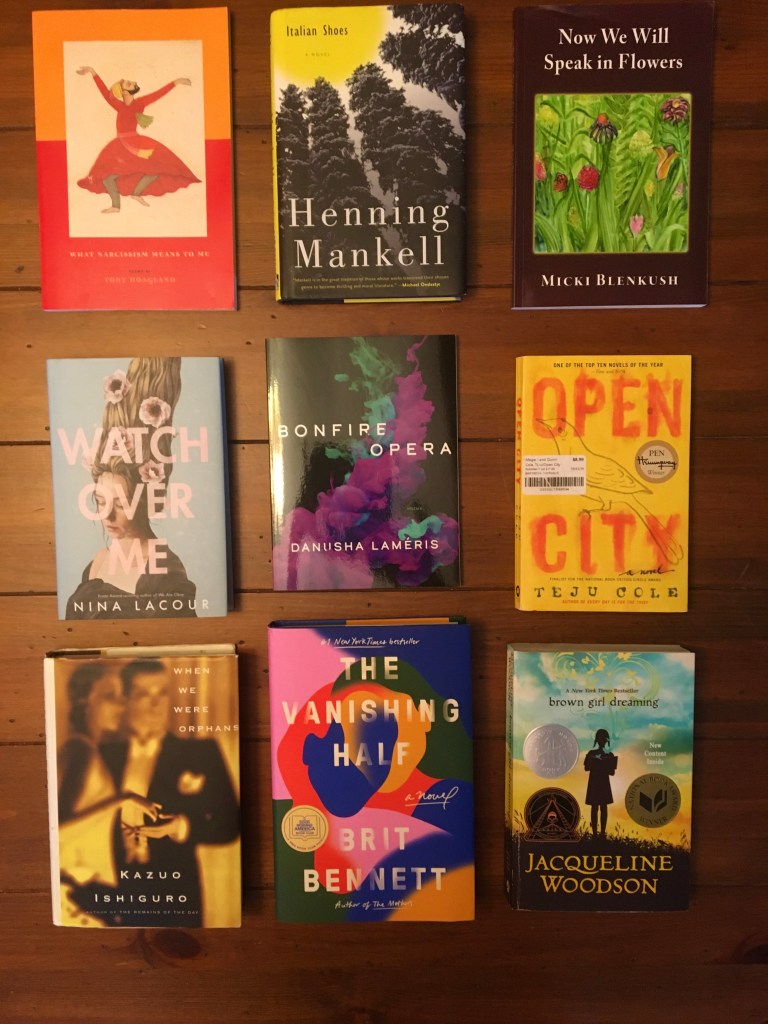
Bonfire Opera, by Danusha Lameris. Oh, I love this woman’s poems. The first time I read Small Kindnesses, I wrote it out by hand and then copied it into my Favorite Poems files. And then scurried over to Magers and Quinn to pre-order Bonfire Opera, the book from whence it came. Lameris writes of ordinary life the way our greatest writers do, the way that allows us to see that no life is ordinary, that our every smallest action ripples out. A beautiful, beautiful book.
Brown Girl Dreaming, by Jacqueline Woodson. I’m late to the party with this lovely book, a memoir in verse-like prose written for middle grades readers but which really, like all great books ostensibly for children, is written for everyone. Woodson writes about her life, from birth through middle school, dipping down into small details the way a hummingbird alights on the sweetest flowers. Each chapter is so brief, so full of love and wonder and subtle commentary on life as a brown girl in the 60s and 70s, and every few chapters is one consisting solely of a haiku that somehow punctuates and coheres the entirety. Such a beautiful book.
The Vanishing Half, by Brit Bennett. This woman is such a good writer. I loved her first novel, The Mothers, and this one is equally absorbing. Identical twins Stella and Desiree, born in the 60s into an almost-mythical small town populated entirely by light-skinned Black citizens, leave home at age sixteen to make their way in the wider world. Stella chooses to “pass” as white, a decision that haunts every aspect of her life thereafter, while Desiree gives birth to a daughter as “black as tar.” Bennett infuses her fictional people with such specificity that their pain, joy, and unbreakable sisterly bonds reveal the intricacies of our nation’s historical racism and sexism while pulling the reader so deeply into their personal life struggles that they will be with me forever.
Italian Shoes, by Henning Mankell. This is my first dip into the vast array of books by renowned Swedish writer Mankell (the man who writes the Kurt Wallander detective series), It’s an intensely serious, quiet novel narrated by a former doctor who, after a tragic surgical mistake, chooses to isolate himself on the island his grandparents left to him, where he is the sole inhabitant. He cuts a hole in the ice of the bay every morning and plunges in – the only time he feels truly alive. Over the course of the novel he encounters, for the first time in decades, a past love who comes in search of him, sparking a small but profound reconnection with the wider world. While I did not love, or even particularly like, the narrator of this book, I remain both haunted and heartened by his inherent sadness and gradual, slow, opening back up to his fellow humans.
Watch Over Me, by Nina LaCour. I loved Nina’s novel We Are Okay and I loved this one too, for the same reasons – her uncanny way with the small, perfect detail that bring both setting and people to life. LaCour writes of the Bay area the way that only an observer with a poet’s eye can, so that the landscape becomes as much a character as the people. Set on a farm for foster-to-adopt children, Watch Over Me follows teenager Mila as she gradually, painfully begins to place pattern to the trauma of her past. LaCour’s descriptions of The Farm are like a dream, the kind of farm where everyone is loved and cared for, where there’s always plenty to eat, plenty of blankets, flowers everywhere, warmth when you need it, solitude when you need it, and, I imagine board games everywhere. The foster parents surround their traumatized charges with the kind of love and support that would heal the entire world should we all be so lucky to experience it. A lovely novel, full of hard-earned hope.
Now We Will Speak in Flowers, by Micki Blenkush. I read this slender book of poetry in one sitting, and felt as if I’d been given a glimpse into the poet’s entire life. Set in northern Minnesota and dipping down into childhood, young adulthood, middle age, town and country and church and work, this is a work set firmly in place and time. The poet’s perspective, wise from experience and innate understanding of how the small and subtle inform the wider world, is captivating in a quiet, gentle way. Lovely.
Open City, by Teju Cole. Set entirely in New York City and almost exclusively in Manhattan, this slender novel follows its main character, a young Nigerian scholar, as he walks about the city. As I read, I kept having to remind myself that it was a novel and not a memoir, so intimate and quiet is the voice of the narrator. As a lifelong walker who soaks up the world through the soles of my feet while silently thinking and observing, the book felt deeply familiar both in its perspective and its essential loneliness. Toward the end, a small scene in a tailor’s shop shocked me. I did not love the main character but I will be thinking about him, and what he has to say about the world we all live in, for a long, long time.
What Narcissism Means to Me, by Tony Hoagland. How I love this man’s poems, and how I wept and wept when he died, too young, of cancer. There are few poets whose poems I almost universally love and treasure; Hoagland is one of them. This book was published in 2003 but no matter, any Hoagland poem lives in its own time and place that transcend the current time and place of the world. Hoagland aches for the world, and life, and his place in it, the same way my own heart does. Go forth and read him.
When We Were Orphans, by Kazuo Ishiguro. Ishiguro’s Never Let Me Go is one of my favorite books of all time. So far, he has not written a book I haven’t loved, although there are several I haven’t yet read. It takes me a while to work up to an Ishiguro novel because I know that a few chapters in, he will have inexorably taken hold of me and pulled me into whatever world he’s created. This one is no exception. Set in London and (mostly) Shanghai in the 1940s, this novel follows Banks, a celebrated London detective, as he attempts to discover why he was orphaned at age nine. Nothing is as it seems in When We Were Orphans, and every small revelation leads the reader further down a path of no return. Quintessential Ishiguro in his understanding of loneliness, longing, and transcendent love.
Look at my mother holding my baby sister in this old photo, how impossibly young and unafraid she looks. I used to carry my babies everywhere like that too, the way every parent does. Cradled in my arms, or with their legs straddling my hip. Hoisted onto my shoulders. Swung across my stomach like a football. Piggyback. Twice I flipped one daughter over onto her belly, half-vertical along my extended arm, to force out a piece of food she was choking on with the heel of my hand.
It’s the most natural thing in the world to carry your baby with just your arms. And at the same time, holy crud, it’s almost unfathomable. How all of us balance on two legs on this floating planet suspended in space, hoisting babies around like footballs. As if they didn’t depend on us for every single second of life, and us on them.
Gravity, by Kim Addonizio
Carrying my daughter to bed I remember how light she once was, no more than a husk in my arms. There was a time I could not put her down, so frantic was her crying if I tried to pry her from me, so I held her for hours at night, walking up and down the hall, willing her to fall asleep. She’d grow quiet, pressed against me, her small being alert to each sound, the tension in my arms, she’d take my nipple and gaze up at me, blinking back fatigue she’d fight whatever terror waited beyond my body in her dark crib. Now that she’s so heavy I stagger beneath her, she slips easily from me, down into her own dreaming. I stand over her bed, fixed there like a second, dimmer star, though the stars are not fixed: someone once carried the weight of my life.
You’re being pulled, but from what and toward what? Everything is in transition. What has your life meant, and what will it mean?
Words from my journal earlier this morning. Questions without answers, written by me to a woman who appeared this morning as I carried my cup of coffee to the small room we call the Fireplace Room because, yup, there’s a fireplace in it. I looked to my left and there she was, in sweats and a pink sweatshirt. The woman looked somewhat familiar but she was not smiling, and her eyes were so serious.
Then I realized she was me, reflected in the mirror on the back of a door that’s been hidden for years by a big bookshelf that I moved yesterday because the door needed painting. There’s a room beyond that door, and another room beyond that door, and I thought of this poem.
from The Door, by Charles Tomlinson
Too little has been said of the door, its one face turned to the night’s downpour and its other to the shift and glisten of firelight.
For more information about Charles Tomlinson, please click here.
Do you ever talk out loud to yourself? Sometimes I do, like last night in my little kitchen, making batches of toffee. To make toffee you have to stir and stir and stir, which is good because I like slow repetitive motion that takes a long time. Soothes me. Then came a voice: What a hard year it’s been, Allie. You’re doing a good job in a hard time. You’re really trying. Me, talking to myself as if I were my own daughter. The room was full of the smell of caramelized brown sugar and butter, and unlike the way I usually talk to myself, which is scolding and impatient, this voice was soft and soothing.
Forgotten Language, by Shel Silverstein
Once I spoke the language of the flowers, once I understood each word the caterpillar said, once I smiled in secret at the gossip of the starlings, and shared a conversation with the housefly in my bed. Once I heard and answered all the questions of the crickets, and joined the crying of each falling dying flake of snow, once I spoke the language of the flowers. . . . How did it go? How did it go?
This morning I pulled a little book off my poetry shelves that looked like the kind of book I used to search through as a teenager, full of poems and aphorisms and quotes about how to live. Where this book came from I don’t know, but someone named Sandy had printed their name in decisive blue ink on the inside cover, and then decisively starred certain poems throughout.
None of Sandy’s starred poems were ones I would’ve picked. But then this familiar little poem below happened along, and the faces of all my students this semester rose up in my mind, smiling out of their little Zoom boxes, cradling cats and dogs and babies, roaming around their apartments with laptops in hand, trying to find a quiet place. All of them showing up, soldiering on in the face of all that’s been thrown at us this year. 2020. Geez. This poem is for everyone out there trying so hard to make a hard time softer.
If I Can Stop One Heart from Breaking, by Emily Dickinson
If I can stop one heart from breaking, I shall not live in vain; If I can ease one life the aching, Or cool one pain, Or help one fainting robin Unto his nest again, I shall not live in vain.
When we were little we weren’t supposed to swim for an hour after we ate, because if we did, cramps will seize you and you’ll sink to the bottom and drown. Or something like that. And when we got drunk or high we were killing off brain cells that would never be replaced, because you were born with all the brain cells you’ll ever have. Or something like that.
Both false, along with a lot of other things. Sometimes I wonder about the things I believed, and maybe still do, like the idea of a soul that’s unchanging and the essence of who we are.
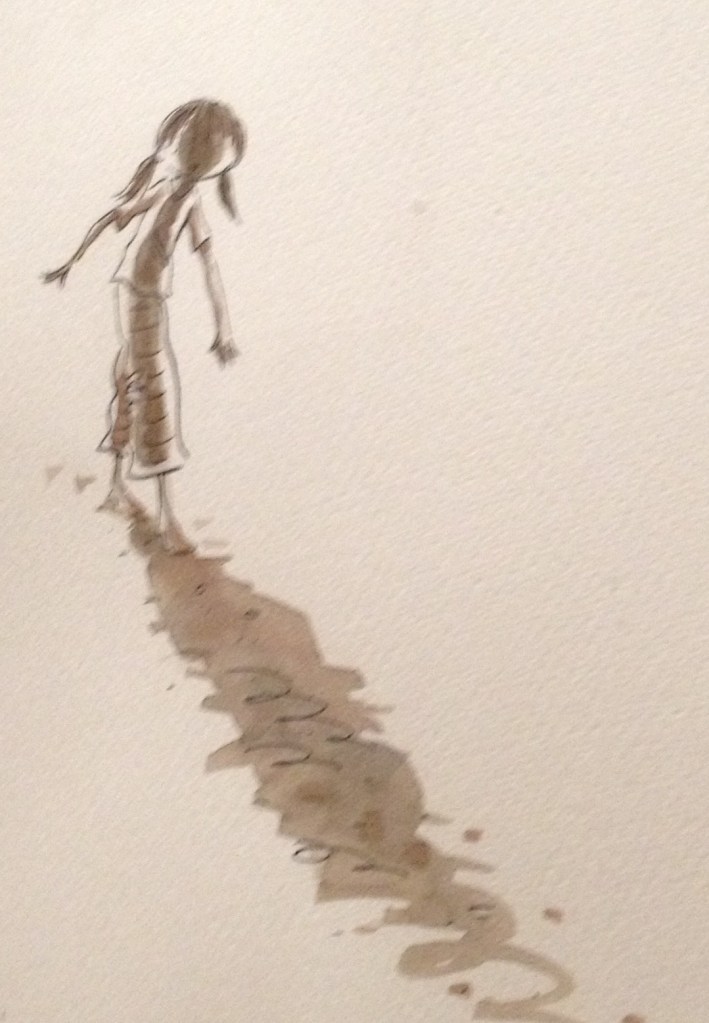
But what if there is no soul? What if the person you are in the moment is just that, the person you are in the moment, not who came before and who will come after? What if everything you forgot isn’t buried inside you somewhere, it’s just. . . gone? These were the questions floating through my mind on a thousand-mile drive last month. The little girl I used to be rose up in my mind, her serious eyes and wondering heart, calling to me from long ago and faraway.
Leaves, by Ursula K. Le Guin
Years do odd things to identity. What does it mean to say I am that child in the photograph at Kishamish in 1935? Might as well say I am the shadow of a leaf of the acacia tree felled seventy years ago moving on the page the child reads. Might as well say I am the words she read or the words I wrote in other years, flicker of shade and sunlight as the wind moves through the leaves.
For more information on Ursula K. Le Guin, click here.
“No regrets” is a phrase and a feeling I don’t understand. Regrets, I have plenty. “But every decision and every choice brought you to where you are right now,” a friend argues, in the latest iteration of a conversation we keep having. “How can you possibly have any regrets, Alison?”
How? Because of the look in my son’s eyes that one summer day. Because of the sound of my daughter’s voice on the phone that one winter evening. Because of the words someone once said to me one dark night, and how I let them lodge inside me and didn’t fight back. How can I possibly nothave regrets? I tell my friend.
No, I wouldn’t change my life, and yes, I would change my life.
Thanks, Robert Frost, by David Ray
Do you have hope for the future? someone asked Robert Frost, toward the end. Yes, and even for the past, he replied, that it will turn out to have been all right for what it was, something we can accept, mistakes made by the selves we had to be, not able to be, perhaps, what we wished, or what looking back half the time it seems we could so easily have been, or ought… The future, yes, and even for the past, that it will become something we can bear. And I too, and my children, so I hope, will recall as not too heavy the tug of those albatrosses I sadly placed upon their tender necks. Hope for the past, yes, old Frost, your words provide that courage, and it brings strange peace that itself passes into past, easier to bear because you said it, rather casually, as snow went on falling in Vermont years ago.
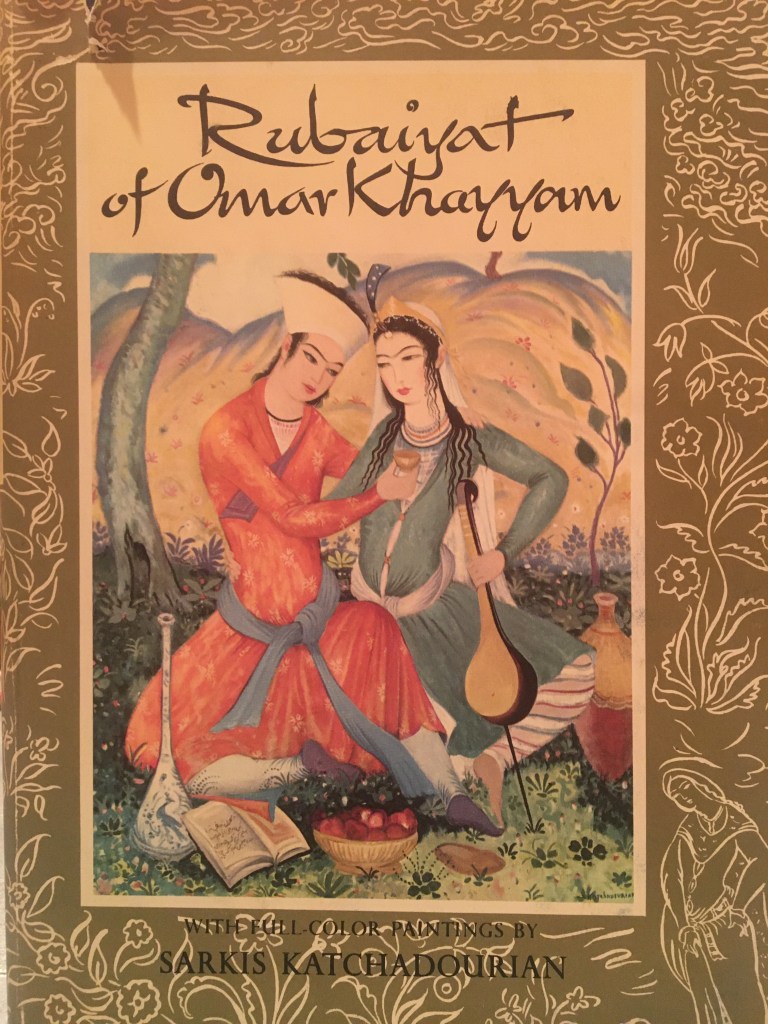
On the way back from a long jog yesterday I glimpsed this book in a little free library. The sight of it brought me straight back to childhood. The poet’s name used to mesmerize me, and so did the poem below, which I copied out as a little girl, knowing its power even then.
Re-reading this poem yesterday was hard. Hard because true or false, willfully ignorant or intentionally misleading, what’s said and done in these troubling times matters. Nothing can be canceled out.
Quatrain 74
The Moving Figure writes, and having writ, Moves on: nor all your Piety nor Wit Shall lure it back to cancel half a Line, Nor all your Tears wash out a Word of it.
It’s not known for sure whether Persian poet and astronomer Omar Khayyam actually wrote all the poems in the Rubaiyat. Click here for more information.
My new poems + reflections podcast, Words by Winter, can be found here.
A friend in college loved the word bittersweet for the way it made him feel, full of a kind of happiness mixed with sorrow. As if he were missing something while it was still happening.
The last time I saw this friend, years ago at a reunion, he used the word again, telling me that even though I was sitting next to him, part of him was already in the future, missing me, and how bittersweet it was.
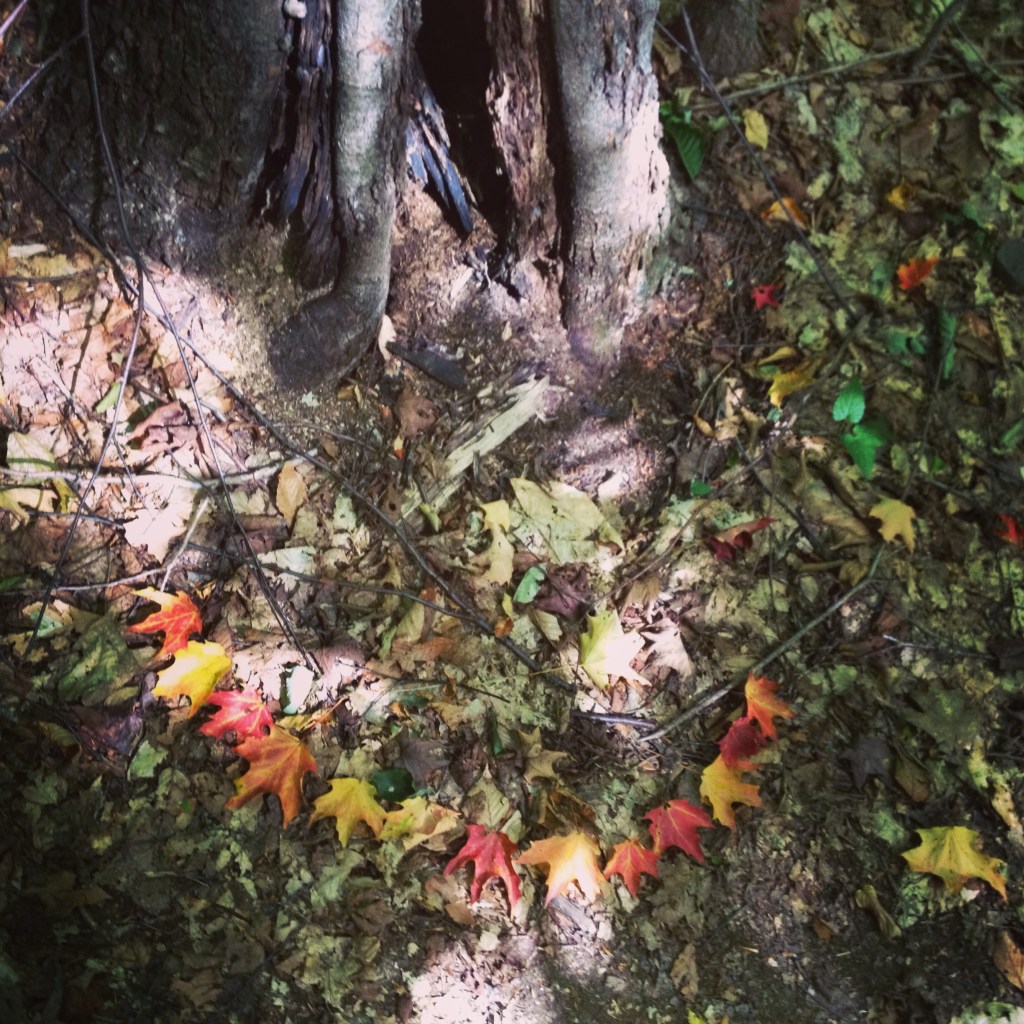
That’s how I think of fall. There is nothing more beautiful to me than leaves turned flame, than air turned crisp, but it’s an aching kind of beauty.
Autumn, by Andrea Gibson
is the hardest season. The leaves are all falling and they’re falling like they’re falling in love with the ground.





 Alison McGhee