Poem of the Week, by Stephan Pastis

Alison and DonaldWe used to call them the funnies, and I have a memory of sitting on my dad’s big lap while he folded the newspaper in half, then quarters, so he could read them to me. This would have been on a Sunday, because I remember the strips as being full-color. I still read the daily comics, even though most of them are terrible – tired, unfunny, boring, and retreading the same exact ground for decades on end. Once in a while a strip comes along that’s electrifyingly good –Calvin & Hobbes, Boondocks, Cul de Sac–but they don’t last long, usually because their creators have the courage to cancel them when they’ve run out of steam. So I read out of habit, with no expectation of transcendence. But every once in a while one of them pierces my heart, like today’s Pearls Before Swine, by Stephan Pastis.


Tree Stump o’ Deep Thought You’re Not Usually Capable Of, by Stephan Pastis

No one knows what we’re doing here.
Some have faith that they do, but no one knows.

So we are scared.
We are alone.
We end.
And we don’t know where we go.

So we cling to money for comfort.
And we chase awards for immortality.
And we hide in the routine of our days.

But then the night.
Always the night.

Which, when it has you alone, whispers that
maybe none of this has any significance.

So love everyone you’re with.
Because comforting each other
on this journey we neither asked for
nor understand
is the best we can do.

And laugh as much as you can.


​For more information on Stephan Pastis, please click here.​

Brand-new upcoming creative writing workshops!


Poem of the Week, by Galway Kinnell

IMG_6637Minnesotans! I’m offering three free workshops this spring on the transformation of trauma. Click here for more information and to register. All are welcome, no writing experience necessary. (Non-Minnesotans, note that I will be adding these to my workshop offerings in the future, and they will always be free.)
Whenever I hear people say “I’m not afraid of death,” I feel a combination of shame and bewilderment, because I am completely afraid of death, and if all these other people aren’t afraid of it, then what am I missing and where am I falling short? I was walking along the beach yesterday, and surfers were out on the waves and I stopped to admire them the way I always do. Sleek black bodies springing up on their boards, riding the foam into shore.

Watching them, it came to me that I was confusing a fear of death with a fear of not being alive. They are two separate things, and I don’t want to not be alive. What I want is more life. More love. More laughter. More surfers. More more more. And then this poem by Galway Kinnell, who died a few years ago and whose poetry I have loved all my life, came singing its way into my head. 

Prayer, by Galway Kinnell

Whatever happens. Whatever
what is is is what
I want. Only that. But that.

For more information on Galway Kinnell, please click here.

My podcast: Words by Winter 


Poem of the Week, by June Jordan

IMG_E8678

I used to assume that the basic principles of U.S. democracy –however unequally and poorly applied– were firmly in place and would remain so, and would see us through this current nightmare. But I don’t believe that anymore. When I read this poem the other day I literally jumped up and cheered, even though I was the only one in the house. The one thing I’d change about it (not that I’d change anything about June Jordan’s poetry, ever) would be to swap out “minorities” in the title for “citizens.” We are not beholden to our elected employees. They are beholden to us. This is our government. Poem of the Week, by the magnificent June Jordan.


Calling on All Silent Minorities, by June Jordan

HEY

C’MON
COME OUT

WHEREVER YOU ARE

WE NEED TO HAVE THIS MEETING
AT THIS TREE

AIN’ EVEN BEEN
PLANTED
YET

For more information on June Jordan, please click here.​

Website
Blog
Facebook page
@alisonmcghee

Poem of the Week, by Lucille Clifton

IMG_6144
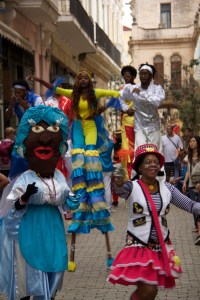
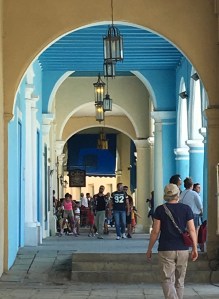
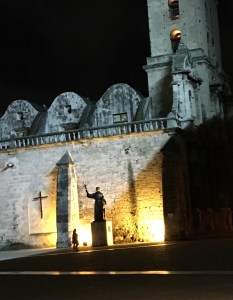
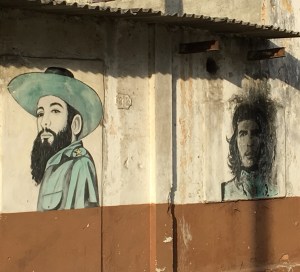
It’s a city of sound, said the Painter, sound and color and light. We were in Havana for a week, soaking it up through the soles of our feet. Miles and miles a day we walked the streets of Habana Vieja, Habana Centro, Vedado. It was gorgeous in an unearthly way, and so were the people.
IMG_E8645
The Cuban men were beautiful, the Cuban women were beautiful, and the Cuban children were beautiful. Everywhere was the sound of music and talking, the frites woman calling her haunting song, laughter and shouting and the high clear tones of solo trumpeters practicing in the far corners of public parks. 
IMG_E8615
There was sadness and frustration too. Our friend, a star baseball pitcher in his youth, recruited by the Yankees —the Yanquis!– for their minor leagues: refused permission by his government to leave the country.
IMG_E8678
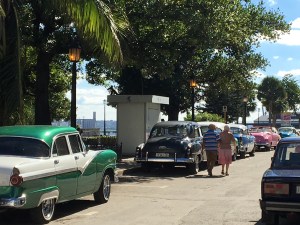
Our other friend who longed to study English abroad, and who could have, had she either the funds or any way to earn enough funds to buy a plane ticket out. Another who had managed, over many years, to save enough money to buy one of the 70-year-old classic American cars so beloved by the tourists, few of whom understand that the charming car represents life support for an entire extended family.
IMG_8647
Another friend who had taught English for twelve years and was now a tour guide who, when I asked her which she preferred, hesitated and then said, “Honestly? Teaching. Teaching is my first love. But you cannot support a family on $25 CUCs a month, and the government knows it but pretends it doesn’t.”
IMG_E8679
We were there for a week, a week filled with poems and songs and stories. The poem below, by one of our greatest American poets, a woman who knew well the power of both womanhood and adversity, keeps coming to mind whenever I think of Habana.
IMG_8741
 
 
homage to my hips, by Lucille Clifton
 
these hips are big hips.
they need space to
move around in.
they don’t fit into little
petty places. these hips
are free hips.
they don’t like to be held back.
these hips have never been enslaved,
they go where they want to go
they do what they want to do.
these hips are mighty hips.
these hips are magic hips.
i have known them
to put a spell on a man and
spin him like a top
 
 
For more information about Lucille Clifton, please click here.

Poem of the Week, by Danez Smith

15844716_10155000188034276_278107369234601833_oI’m thinking of the man in the white shirt and the black pants, the one holding a briefcase, who stepped in front of the tanks in Tiananmen Square and stood there. I’m thinking of the girl in the long dress, the one who slid a flower into the barrel of the gun the officer had trained on her. I’m thinking of the woman who began a conversation with and ended up becoming a second mother to the boy who murdered her own son. I’m thinking of this tiny beautiful prayer by Danez Smith. A new year to all. May ruin end here.


Little Prayer
Danez Smith

let ruin end here

let him find honey
where there was once a slaughter

let him enter the lion’s cage
& find a field of lilacs

let this be the healing
& if not    let it be


​For more information on Danez Smith, please click here.​


Poem of the Week, by Madeleine L’Engle

img_6107“It was a time like this. . . when all things fall apart.”

Once, long ago, I sat in the office of someone I was paying to listen to me and told her, crying and crying, all the ways that my life had fallen apart. The room felt close and narrow and so did the horizons of my world. Everything is broken, I said. I broke everything.

She listened and listened and then, unlike most people paid to listen, she sat up straight and leaned forward and fixed me with fierce eyes. And when you break something, like a bowl, what do you do? she said. You glue it back together or you go out and get a new one. This is your responsibility: to build a new life, and now. Not to sit around and cry. Get out there and get going.

Things are always falling apart. And it is always our responsibility to build them back up. So keep the faith, friends, keep the faith. Here’s to the coming new year. 


Into the Darkest Hour

            – Madeleine L’Engle 

It was a time like this,
war & tumult of war,
a horror in the air.
Hungry yawned the abyss –
and yet there came the star
and the child most wonderfully there.

It was a time like this
of fear & lust for power,
license & greed and blight –
and yet the Prince of bliss came into the darkest hour
in quiet & silent light.

And in a time like this
how celebrate his birth
when all things fall apart?
Ah! Wonderful it is:
with no room on the earth,
the stable is our heart.

​For more information on Madeleine L’Engle, please ​click here.


Website
Blog
Facebook page
@alisonmcghee


Poem of the Week, by Li-Young Lee

img_5354Thirty years ago I stood in a kitchen reading through a letter of complaint sent to a business about one of their products. “Oh my God,” I remember saying. “Whoever wrote this letter is a horrible speller. And the grammar? Jeez!” Then I turned the page over and looked at the signature. And realized that the letter had been written by someone I loved, someone who had worked incredibly hard their whole life long, someone who could always be counted on to help, someone who was right there in the room. 

That memory has haunted me ever since. When I think about it, the sensation of shame that flooded through me in that moment, that almost made me fall on my knees, was the beginning of a long slow road that brought me to where I am now, a writer and a teacher of writing who doesn’t care how bad her students’ spelling and grammar are. I am so so sorry, a student wrote me last week, thank you for being so patient and correcting my horrible spelling. All my terrible mistakes must feel like fingernails on a chalkboard to you.

But they don’t. I don’t care anymore about things like that. The surface doesn’t matter to me. Years and years of listening to others’ stories and watching others’ faces when their mistakes are pointed out, when they’re being laughed at, when they smile and smile and smile while their eyes fill with tears, have softened and gentled me. They have turned me into someone who will sit with her laptop propped on her lap and spend whatever time it takes to see through to the golden, glowing sun that shines beneath all those halting sentences. 


Persimmons, by Li-Young Lee

In sixth grade Mrs. Walker 
slapped the back of my head 
and made me stand in the corner  
for not knowing the difference  
between persimmon and precision.  
How to choose 

persimmons. This is precision. 
Ripe ones are soft and brown-spotted.  
Sniff the bottoms. The sweet one 
will be fragrant. How to eat: 
put the knife away, lay down newspaper.  
Peel the skin tenderly, not to tear the meat.  
Chew the skin, suck it, 
and swallow. Now, eat 
the meat of the fruit, 
so sweet, 
all of it, to the heart. 

Donna undresses, her stomach is white.  
In the yard, dewy and shivering 
with crickets, we lie naked, 
face-up, face-down. 
I teach her Chinese. 
Crickets: chiu chiu. Dew: I’ve forgotten.  
Naked:   I’ve forgotten. 
Ni, wo:   you and me. 
I part her legs, 
remember to tell her 
she is beautiful as the moon. 

Other words 
that got me into trouble were 
fight and frightwren and yarn
Fight was what I did when I was frightened,  
Fright was what I felt when I was fighting.  
Wrens are small, plain birds,  
yarn is what one knits with.
Wrens are soft as yarn. 
My mother made birds out of yarn.  
I loved to watch her tie the stuff;  
a bird, a rabbit, a wee man. 

Mrs. Walker brought a persimmon to class  
and cut it up 
so everyone could taste 
Chinese apple. Knowing 
it wasn’t ripe or sweet, I didn’t eat 
but watched the other faces. 

My mother said every persimmon has a sun  
inside, something golden, glowing,  
warm as my face. 

Once, in the cellar, I found two wrapped in newspaper,  
forgotten and not yet ripe. 
I took them and set both on my bedroom windowsill,  
where each morning a cardinal 
sang, The sun, the sun

Finally understanding  
he was going blind, 
my father sat up all one night  
waiting for a song, a ghost.  
I gave him the persimmons,  
swelled, heavy as sadness,  
and sweet as love. 

This year, in the muddy lighting 
of my parents’ cellar, I rummage, looking  
for something I lost. 
My father sits on the tired, wooden stairs,  
black cane between his knees, 
hand over hand, gripping the handle. 
He’s so happy that I’ve come home. 
I ask how his eyes are, a stupid question.  
All gone, he answers. 

Under some blankets, I find a box. 
Inside the box I find three scrolls. 
I sit beside him and untie 
three paintings by my father: 
Hibiscus leaf and a white flower. 
Two cats preening. 
Two persimmons, so full they want to drop from the cloth. 

He raises both hands to touch the cloth,  
asks, Which is this

This is persimmons, Father

Oh, the feel of the wolftail on the silk,
the strength, the tense
precision in the wrist.
I painted them hundreds of times
eyes closed. These I painted blind.
Some things never leave a person:
scent of the hair of one you love,
the texture of persimmons,
in your palm, the ripe weight.


​For more information on Li-Young Lee, please ​click here.

Poem of the Week, by Elizabeth Alexander

IMG_4305A house I used to live in was filled with a dark and ominous energy that I felt every time I approached the front door. When I dreamed, dark birds hovered silently in the air around me, landing on my shoulders and head. The dark birds wanted me — they wanted me dead. I lived in a state of permanent exhaustion, surrounded by the forces of darkness. 

Two choices: I could sell the house or I could fight. Fighting was worth a shot. One sunny day, I dragged my furniture outside and set it on the walkway. I hauled out the rugs and beat them with a stick. I filled a bucket with hot water and soap, scrubbed the furniture, opened up the doors and windows and went back inside and scrubbed the walls and counters and cabinets. 

The darkness began to lift, but it wasn’t enough. So I ran around windmilling my arms and yelling at the dark birds to Go away, get the hell out of here, fuck you, you will not suck me down. Then I blasted music and kept cleaning and concentrated my inward energy on driving the invisible birds away. When I returned in the morning, everything was different. The forces of darkness had been driven away. 

This is a true story. I was close to losing my life. But all it took to drive out the darkness was me, standing up to it with soap and water and sunlight and resolve. Dark energy is at work right now in this country. When you wake in the night from apocalyptic dreams, when you wake in the morning terrified of what the news will bring, that’s the virus seeking entry into you. The only antidote is to gather your own forces of light and fight. We have so much more power than we think we do. 


Praise Song for the Day, by Elizabeth Alexander

Each day we go about our business,
walking past each other, catching each other’s
eyes or not, about to speak or speaking.
All about us is noise. All about us is
noise and bramble, thorn and din, each
one of our ancestors on our tongues.
Someone is stitching up a hem, darning
a hole in a uniform, patching a tire,
repairing the things in need of repair.
Someone is trying to make music somewhere,
with a pair of wooden spoons on an oil drum,
with cello, boom box, harmonica, voice.
A woman and her son wait for the bus.
A farmer considers the changing sky.
A teacher says, Take out your pencils. Begin.
We encounter each other in words, words
spiny or smooth, whispered or declaimed,
words to consider, reconsider.
We cross dirt roads and highways that mark
the will of some one and then others, who said
I need to see what’s on the other side.
I know there’s something better down the road.
We need to find a place where we are safe.
We walk into that which we cannot yet see.
Say it plain: that many have died for this day.
Sing the names of the dead who brought us here,
who laid the train tracks, raised the bridges,
picked the cotton and the lettuce, built
brick by brick the glittering edifices
they would then keep clean and work inside of.
Praise song for struggle, praise song for the day.
Praise song for every hand-lettered sign,
the figuring-it-out at kitchen tables.
Some live by love thy neighbor as thyself,
others by first do no harm or take no more
than you need. What if the mightiest word is love?
Love beyond marital, filial, national,
love that casts a widening pool of light,
love with no need to pre-empt grievance.
In today’s sharp sparkle, this winter air,
any thing can be made, any sentence begun.
On the brink, on the brim, on the cusp,
praise song for walking forward in that light.

For more information on Elizabeth Alexander, please click here.

Poem of the Week, by Piyassili

pigs-eye-2014Hey there, elected employees, thanks for an especially sickening week. Proud of yourselves and your ongoing attempts to destroy our democracy? It sure takes a ton of energy to stay steadfast and determined in the face of your continuing refusal to stand up for what’s right. I turn to the poets for solace and strength. And solidarity.

Thank you, Piyassili of Assyria, for writing this poem. How I wish it weren’t as meaningful today as it was more than three thousand years ago.


Injustice, by Piyassili, Assyria, 1218 BC

The people who are made to feel ashamed every day
are not the people who should feel ashamed.
The people who should feel ashamed
are the people unable to feel ashamed
yet heap shame by the bundle every day
on the troubled, the poor and despised.


For more information on Piyassili, please click here.