Poem of the Week, by Alison McGhee
Whether you’re a parent or not, everyone was once someone’s child. This one goes out to all of you.
Bargain
– Alison McGhee
The newspaper reports that at twilight tonight
Venus and Jupiter will conjoin
in the southwestern sky,
a fist and a half above the horizon.
They won’t come together again for seventeen years.
What the article does not say is that Mercury, the
dark planet, will also be on hand.
He’ll hover low, nearly invisible in a darkened sky.
I stare out the kitchen window toward the sunset.
Seventeen years from now, where
will I be?
Mercury, Roman god of commerce and luck,
let me propose a trade:
Auburn hair, muscles that don’t ache, and a seven-minute mile.
Here’s what I’ll give you in return:
My recipe for Brazilian seafood stew, a talent for
French-braiding, an excellent sense of smell and
the memory of having once kissed Sam W.
Then I see my girl across the room.
She stands on a stool at the sink,
washing her toy dishes and
swaying to a whispered song,
her dark curls a nimbus in the lamplight.
The planets are coming together now.
Minute by minute the time draws nigh for me to watch.
Minute by minute my child wipes dry her red
plastic knife, her miniature blue bowls.
Mercury, here’s another offer, a real one this time:
Let her be.
You can have it all in return,
the salty stew, the braids, the excellent sense of smell
and the softness of Sam’s mouth on mine.
And my life. That too.
All of it I give for this child, that seventeen years hence
she will stand in a distant kitchen, washing dishes
I cannot see, humming a tune I cannot hear.

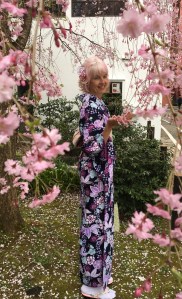 This post comes to you after a week in Japan, a country I’d never been before, where the kindness and gentleness of everyone I met almost overwhelmed me. An hour ago I watched the wondrous city of Tokyo recede in the distance below the plane I’m on, and then the sun set, and we headed into a vast stretch of darkness miles above the Pacific Ocean. The sky from inside an airplane is darker, bigger and somehow smaller at the same time. The air outside the window next to me is so thin I’d black out if I breathed it. Everyone in the world breathes the same constantly recycling air. We all inhabit the same small and huge planet.
  Last week I dreamed a dream so disturbing that I was afraid to google its meaning and asked the Painter to do so for me. The closest interpretation I can find says it’s about something you once dreamed of doing, he said. You want to reclaim something you’ve lost in yourself.
  There was a time in my life when, if I saw a dark bird on my lawn staring at me, I worried that someone I loved was about to be hurt. Certain people around me believed in signs and superstitions and I, with porous borders, took on their fears.
  My daughter and I were in Istanbul for a week, our first time in a country where the call to prayer sounded five times a day. I remember sitting by the window at sunset as the song of the muezzins rose in the air. It was beautiful and unearthly and I wanted to hold onto it so it would never end. It’s an almost panicky feeling, that wanting to hold on. Long ago, as a means of coping with it, I began to tell myself that You can always come back, Alison.
  The suicide of Alan Krueger last week, a man I didn’t know but whose work I admire, a man clearly beloved by so many, hit me hard. It brought me back to my early twenties, when the suicide of someone I loved both ended his life and permanently altered mine. Crying comes hard to me and does not bring relief, but it came anyway this week. At one point I found myself alone, apologizing out loud for things I wish I’d done differently.
  One of the top-rated MFA programs in the country once recruited me to fly out and interview for a fiction position. A day into the interview, deep in discussion of teaching technique with the faculty and students, I subtly began to portray myself as less interested in criticism and more interested in nurturing a creative spark. This wasn’t what they wanted in a teacher and I knew it. I was in effect throwing the interview, but I wasn’t sure why.
  A few days ago at sunset the sky was unearthly. The Painter came home, grabbed his camera and tripod and headed to the beach to take a bunch of photos. My internal, unspoken take on this, having never seen him take a sunset photo before: You had a frustrating day in the studio. Nothing was working with your paintings. You feel blocked, so you’re trying something new, to change up the energy and get things moving again.
  We were classmates. He was a country kid, like me, and like me, he was condemned to ride the bus for miles and miles. I dreaded that bus every day of my life –it was a place of fear and intimidation and endless cruelty.
  Alison McGhee