Poem of the Week, by Lisel Mueller

It must be awful to watch TV next to me, the way I constantly put my hands over my ears, or murmur about the specifics of someone’s voice, or the strange way news anchors inflect their syllables, or oh no oh no there’s that song again, where’s the remote so I can mute it. I am the woman you see in crowds stuffing bits of wadded-up tissue into her ears. Sound is visible to me, literally – words and music and ambient noise have shape and color and texture – and it overwhelms me.
A couple of years ago when the Painter said “Here, try these,” and put his noise-canceling headphones over my ears, the relief was so great I almost cried. The world is so full of noise. Hard to imagine what it would feel like if it were more intense than it already is for intense me. What if we could hear our own cells growing? Our consciousness expanding? The earth breathing?
What the Dog Perhaps Hears, by Lisel Mueller
If an inaudible whistle
blown between our lips
can send him home to us,
then silence is perhaps
the sound of spiders breathing
and roots mining the earth;
it may be asparagus heaving,
headfirst, into the light
and the long brown sound
of cracked cups, when it happens.
We would like to ask the dog
if there is a continuous whir
because the child in the house
keeps growing, if the snake
really stretches full length
without a click and the sun
breaks through clouds without
a decibel of effort,
whether in autumn, when the trees
dry up their wells, there isn’t a shudder
too high for us to hear.
What is it like up there
above the shut-off level
of our simple ears?
For us there was no birth cry,
the newborn bird is suddenly here,
the egg broken, the nest alive,
and we heard nothing when the world changed.
For more information on Lisel Mueller, please read her bio at the Poetry Foundation.

 At a wedding last weekend I sat near a curvy, beautiful woman with a deep voice who radiated a wild and warm confidence. She was free with opinions and didn’t care what others thought; an artist expressed admiration for a specific modern museum and she laughed outright.
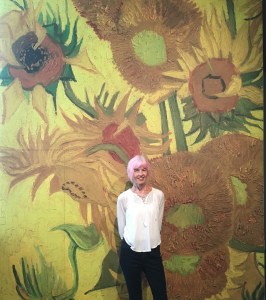 Last week I stood reading Vincent Van Gogh’s letters to his brother Theo. Back then the mail came two or three times a day, sometimes overnight from Paris to Amsterdam or wherever Vincent was living: the yellow house in France, the room in his parents’ house where he would sometimes retreat, from behind the barred window of the asylum where he committed himself.
 At a museum yesterday I sat and stared at this painting. It transported me to a world with a wooden school desk and a clock ticking on the wall. The hot waxy smell of melted crayons. Balloons in a summer rain sinking slowly to the ground. A miniature wooden circus in a clearing in the woods. Indistinct voices in the distance playing some kind of game.
 In second grade one of my classmates died of a common childhood disease that most of us weathered without incident. One day he was at his desk in the row next to the door, and the next day he wasn’t. In my mind I see him as he was in his Picture Day photo: dark hair parted on the side, sweater over shirt.
 Once, at a Twins play-off game, I sat next to an older couple. They opened a tote and pulled out sandwiches wrapped in waxed paper, peeled carrots, small bags of grapes, and cookies. Dinner, packed at home and brought to the game. There was something about this couple I loved.
 Alison McGhee