Poem of the Week, by Sean Thomas Dougherty

IMG_3702

Mr. Kraft and his family lived in the town of 300 I grew up five miles north of. One day when I was about nine, he and my mother stood talking in his driveway. He nodded to me at one point and said quietly to my mother, “She’s got it.”

She, meaning me. Got it, as in. . . I don’t know what. But those three words have seen me through every rough patch of my entire life. Every awful conversation, every time someone has tried to tear me down, and also in those dark and frequent moments when I think, You’re a failure, Alison. 

I remember how still I stood in Mr. Kraft’s driveway that day, how something lifted from my shoulders, how the world suddenly seemed bigger and kinder. I thought of him again when I read this poem. Wherever you are now, Mr. Kraft, in whatever far-off universe, know how you softened the world for a small girl that day, and how she never forgot your words.


Why Bother, by Sean Thomas Dougherty

Because right now there is someone
out there with
a wound in the exact shape
of your words.


For more information about Sean Thomas Dougherty, please check out his website.

 
Twitter and Instagram: @alisonmcgheewriter 

Poem of the Week, by Yusef Komunyakaa

img_1857Hiking the other day up a steep and narrow trail, my eyes kept searching for where I should step next. And then my feet kept setting themselves down exactly where I wanted them to be. I didn’t have to look at them; they knew what to do. But how? How does this body of mine know how to do all the things it just. . . does? Dance and run and knead dough and type and shuffle a deck of cards and tell me when I’m hungry or cold or full or tired?  How do all those signals make their magic way from eyes to brain to nerves to muscle and bone? Even though I don’t play basketball I felt my own self moving to every line of this beautiful spin of a poem. My body, all our bodies, are wondrous. 
 

Slam, Dunk and Hook, by Yusef Komunyakaa

Fast breaks. Lay ups. With Mercury’s
insignia on our sneakers,
we outmaneuvered the footwork
of bad angels. Nothing but a hot
swish of strings like silk
ten feet out. In the roundhouse
labyrinth our bodies
created, we could almost
last forever, poised in midair
like storybook sea monsters.
a high note hung there
a long second. Off
the rim. We’d corkscrew
up & dunk balls that exploded
the skullcap of hope & good
intention. Lanky, all hands
& feet…sprung rhythm.
We were metaphysical when girls
cheered on the sidelines.
tangled up in a falling,
muscles were a bright motor
double-flashing to the metal hoop
nailed to our oak.
When Sonny Boy’s mama died
he played nonstop all day, so hard
our backboard splintered.
Glistening with sweat,
we rolled the ball off
our fingertips. Trouble
was there slapping a blackjack
against an open palm.
Dribble, drive to the inside,
& glide like a sparrow hawk.
Lay ups. Fast breaks.
We had moves we didn’t know
we had. Our bodies spun
on swivels of bone & faith,
through a lyric slipknot
of joy, & we knew we were
beautiful & dangerous.

For more information about Yusef Komunyakaa, please click here

My websiteMy blogMy Facebook page

Twitter and Instagram: @alisonmcgheewriter 

Poem of the Week, by Pauletta Hansel

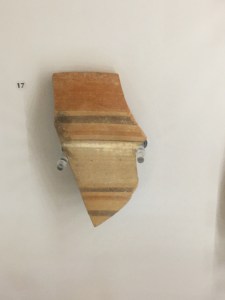
IMG_6101This shard of pottery is from a storage container used by an unknown someone who lived on a hill in Lisbon almost three thousand years ago. I imagine her filling the original container with soup or stew or pickles or water, then scouring it out, day after day.

Sometimes I picture the potter who made it, how they shaped its curves, worked the clay, painted those stripes with care and attention so that the pot would be beautiful. Doesn’t matter where we are or who we are or how poor or how worried or stressed or tired our lives, we make things beautiful because we want to, because we can. Because it’s a gift we can give ourselves. 


The Road, by Pauletta Hansel

Where I’m from, everybody had a flower garden,
and I’m not talking about landscaping—
those variegated grasses poking up between
the yellow daylilies that bloom more than once.
Even the rusted-out trailer down in the green bottoms
had snowball bushes that outlived the floods.
Even the bootlegger’s wife grew roses up the porch pillar
still flecked with a little paint, and in the spring
her purple irises rickracked the rutted gravel drive.
Even the grannies changed out of their housedresses
to thin the sprouts of zinnias so come summer
they’d bloom into muumuus of scarlet and coral
down by the road.
Now driving that road that used to take me home,
I think how maybe it’s still true.
Everybody says down here it’s nothing
but burnt-out shake and bakes and skinny girls
looking for a vein, but everywhere I look
there’s mallows and glads, begonias in rubber tire
planters painted to match, cannies red
as the powder my mother would pat high
on her cheekbones when she wanted to be noticed
for more than her cobblers and beans.
Everywhere there’s some sort of beautiful
somebody worked hard at, no matter
how many times they were told
nobody from here even tries.

For more information about Pauletta Hansel, please click here.

My websiteMy blogMy Facebook page

Twitter and Instagram: @alisonmcgheewriter 

Poem of the Week, by Tom Sastry

IMG_2194Before taking the city bus for the first time, I was scared. How much does it cost and what if you don’t have exact change and what are those green cards everyone else seems to be holding and oh crap what about that scanner thingie? Etcetera.
“Help. This is my first time ever on the bus,” I said once onboard. The driver and everyone who heard me looked up and smiled. “Hello!” “Welcome!” “Congratulations!” They showed me how to pay, asked where I was going, showed me how to pull the stop cord.

Giving up and admitting my cluelessness like that changed me, relaxed me. Help. I have no idea what I’m doing. When I read this poem I thought of that long-ago ride bus ride.


Hanging out with musicians, still in my suit, by Tom Sastry

He said fucking and that was important:
“We’re all fucking broken.”
He said it gently
like a priest, soothing the smart of sin.

I hadn’t heard about it before
this shared brokenness
and it was new to me, this idea
that being in pieces could bring us together

so my mind worked through all the things he might mean
and
like the fourteen-stone word-association machine that I am
I remembered all the world’s once-complete, now-shattered things

until I couldn’t get it out of my head
that we were broken like jigsaws
fucking broken like fucking jigsaws
and it felt right and wise and true.


​For more information about Tom Sastry, please click here.


My websiteMy blogMy Facebook page.

Twitter and Instagram: @alisonmcgheewriter


Poem of the Week, by Mike White

IMG_0696A few years ago, from my front porch, I watched an enormous, dark turtle labor its way across Emerson Avenue. It was winter. Snow and ice and slush. A giant turtle? Then the scene resolved itself; the turtle was not a turtle but an old man who had fallen and was trying to crawl to the curb.

I ran out and helped him up and got his walker securely situated. He refused my offer of a ride and carried on down the sidewalk. Sometimes the world turns itself inside out for a few seconds and you stand there entirely confounded. All you can do is wait, and wonder, and let yourself be amazed.


Wind, by Mike White

Not a remarkable wind. 
So when the bistro’s patio umbrella 
blew suddenly free and pitched 
into the middle of the road, 
it put a stop to the afternoon. 

Something white and amazing 
was blocking the way. 

A waiter in a clean apron 
appeared, not quite 
certain, shielding his eyes, wary 
of our rumbling engines. 

He knelt in the hot road, 
making two figures in white, one 
leaning over the sprawled, 
broken shape of the other, 
creaturely, great-winged, 
and now so carefully gathered in.


For more information about Mike White, please check out his website.

My websiteMy blogMy Facebook page.
Twitter and Instagram: @alisonmcgheewriter 

Poem of the Week, by Lucille Clifton

IMG_E8618On the surface there’s little in common between Lucille Clifton and me besides the fact that we both grew up in far upstate New York (which, as all upstaters know, is in fact a deep and powerful bond). But ever since I read The Lost Baby Poem in my early twenties, a poem that filled me with so much sorrow and pain and understanding that it felt as if I were somehow embedded in it, she has been a kindred spirit.

She writes an homage to her big hips that makes me want to shake my skinny ones. She writes about her cancer diagnosis and my hands cover my breasts. She writes what did i see to be except myself and that, too, I feel in my bones. 


Won’t You Celebrate With Me, by Lucille Clifton

won’t you celebrate with me
what i have shaped into
a kind of life? i had no model.
born in babylon
both nonwhite and woman
what did i see to be except myself?
i made it up
here on this bridge between
starshine and clay,
my one hand holding tight
my other hand; come celebrate
with me that everyday
something has tried to kill me
and has failed.


For more information about Lucille Clifton, please click here.
 
Twitter and Instagram: @alisonmcgheewriter 

Poem of the Week, by Maggie Smith

IMG_4264Would your life be worse then than it is right now? is a question to ask yourself when you wake up every day in fear and dread of something that hasn’t happened but might happen. Something you fight and fight and work and work to prevent happening, to you or to someone you love. Foreclosure. Suicide. Recurrence of cancer. Loss of a job, a friend, a romance.

At some point the panic might be so huge that it takes over your life, and what then? Then a balance has been achieved. The thing you so fear has, in the fearing of it, destroyed your peace, your health, your daily existence. So. If the thing you fear actually happened, would your life be worse than it is right now? 

Maybe. Maybe not. Maybe something else would rush in once the anticipatory dread and panic are finally gone, something huge and unfamiliar: relief. This poem brought so many feelings flooding through me.


At the End of My Marriage, I Think of Something My Daughter Said about Trees, by Maggie Smith 

When a tree is cut down, the sky’s like 
finally, and rushes in. 

Even when you trim a tree, 
the sky fills in before the branch 

hits the ground. It colors the space blue 
because now it can.


For more information about Maggie Smith, please check out her website.


My websiteMy blogMy Facebook page

Twitter and Instagram: @alisonmcgheewriter 

Poem of the Week, by Sharon Olds

IMG_2137This past week: the friends in a group discussion admitting they can barely ask what the honorarium is because it feels so selfish. The friend who wonders can I back out of this event in NYC because I just noticed there’s no travel reimbursement and I literally can’t afford it but I can’t stand to let anyone down. The friends who say they know it’s their own fault for feeling ashamed of their bodies and why can’t they just ignore all the ads for liposuction, juvaderm, lip filler, neck filler, breast augmentation, tummy tucks, and vaginal rejuvenation.

The first time I read the poem below, many years ago when my children were tiny, my heart pounded and I was glad to be alone. It felt as if anyone who saw my visceral reaction would know something elemental about me, something I couldn’t stand for them to know about the hugeness of my drive and determination, and how shameful that was, how selfish. It is so much harder for some people than others to stand tall, to take up space in this world, to say no, to stop apologizing. Lines from this poem still filter through me like blood. 


Station, by Sharon Olds

Coming in off the dock after writing,
I approached the house,
and saw your long grandee face
in the light of a lamp with a parchment shade
the color of flame.

An elegant hand on your beard. Your tapered
eyes found me on the lawn. You looked
as the lord looks down from a narrow window
and you are descended from lords. Calmly, with no
hint of shyness you examined me,
the wife who runs out on the dock to write
as soon as one child is in bed,
leaving the other to you.

Your long
mouth, flexible as an archer’s bow,
did not curve. We spent a long moment
in the truth of our situation, the poems
heavy as poached game hanging from my hands.


For more information about Sharon Olds, please click here.


My websiteMy blogMy Facebook page

Twitter and Instagram: @alisonmcgheewriter 


Poem of the Week, by Dean Young

IMG_3673As a kid desperation used to fill me for more, more, more, but I couldn’t put words to the panicky feeling beyond once telling my mother that “I don’t want to be normal. I don’t want a normal life,” knowing even then that “normal” wasn’t exactly the right word. 

More of everything is what I wanted: more sky, more wind, more space, more freedom more travel more music more poems more love more life. As I type these words my own voice in my own head keeps whispering more in italics. 

Every line of the poem below, hopping and skipping from more to more, skimming through a life and dipping down into the wild hunger and hurt and joy bursting out of it, feels familiar to me. Then the last line made me laugh out loud, and all I could think was: Yeah. This guy wants everything, too.


New Restrictions, by Dean Young

It doesn’t matter how many
Wallace Stevens poems you’ve memorized
or if you had sex in the graveyard
like an upside-down puppet
or painted your apartment red
so it feels like sleeping inside a heart
or the trees were frozen with ravens
which you sent pictures of to everyone you know
or your pie dough’s perfect
or you once ran a sub-5-minute mile
or you’re on the last draft
of your mystery novel and still
don’t know if the vicar did it
or every morning that summer
you saw a fox stepping through the fog
but it got no closer
or once you helped drag a deer
off the road by the antler
sit blinked
or which song comes from which side
of your mouth as you drive
all night all night all night
or how deep and long you carry
a hitch in your breath after crying
or shot a man in Tennessee
or were so happy in France
or left your favorite scarf in a café,
the one with the birds and terrible art
or the Klimt
or you call your mother once a week
even after she’s dead
or can’t see a swan without panic
or have almost figured out
what happened to you as a child,
urge, urge, nothing but urge
or 600 daffodils
or a knife in the glove box
or a butterfly on a bell,
you can’t park here.


For more information on Dean Young, please click here.
Twitter and Instagram: @alisonmcgheewriter 

Poem of the Week, by William Butler Yeats

IMG_5657This was back in the days of dial-up modems with their squealy screechy sounds. The first line of the first review of my first novel came shimmering up on that clunky old computer screen: “First time novelist tries but fails to move or matter.” 

Or matter.”

I sat staring at the screen, my little kids looking at me silent and troubled, knowing something was wrong. I turned to them and smiled. I laughed about the review, pretended I didn’t care. But the photo above is what I typed into my journal that night.

This is not a story about a writer who got a bad review – all writers get bad reviews. Nor is it a story about a plucky young woman whose novel went on to win a bunch of awards so haha. It’s a tiny story that stands in for a much larger story of casual, ongoing cruelty in a world in which those two words –or matter–should never be written by a human being about another human being. 

Those two words broke something in me a long time ago that can’t be fixed. That’s what cruelty does. When judgment rears its ugly head inside me, as it does way too often, I recite the last two lines of this poem to myself.


He Wishes for the Cloths of Heaven, by William Butler Yeats

Had I the heavens’ embroidered cloths,
enwrought with golden and silver light,
the blue and the dim and the dark cloths
of night and light and the half-light,
I would spread the cloths under your feet:
But I, being poor, have only my dreams;
I have spread my dreams under your feet;
tread softly because you tread on my dreams.

For more information on Yeats, please click here.

Twitter and Instagram: @alisonmcgheewriter