Poem of the Week, by Ginny Lowe Connors
 Like many other patriotic citizens these days, free-range anxiety keeps waking me up in the middle of the night: health care, sexual assault, violence, our natural world, the crumbling of the democratic principles laid out in our constitution. Brutality in many and repulsive forms, from public mockery to online assaults. I’ve always been critical of what I see as the wrongs of some of my nation’s policies. But I never knew until now how much I love my country and how much I want it to keep righting its wrongs instead of retreating into some mythological past that served only one small segment of its citizens. The strange and powerful little poem below haunts me. No no no no no, is how most of its lines begin, and No no no no no is my response. I dream I’ve been captured forced into a cage, which is exactly why next weekend, my son and my daughters and I and many thousands of others will be descending on our nation’s capital to take a stand against fascism.
Betty Parris Hears Only No
– Ginny Lowe Connors
daughter ef the R.everend Parris
No running no dancing no wasting of time
No power no nonsense opinions or rage
All of our stitches must march a straight line
No running no dancing no wasting of time
Stubbornness ugly defiance a crime
I dream I’ve been captured forced into a cage
No running no dancing no wasting of time
No power no nonsense opinions or rage
For more information on Ginny Lowe Connors, please click here.
 Hello, you’ve reached the Crisis Connection. This is Anna. Could you tell me your first name? I remember the sound of that woman’s voice. This was many many years ago. Someone close to me was in terrible shape, and nothing I did helped, and in panic and desperation I had called the hotline seeking guidance as to how to help. My name is Alison but that doesn’t matter it’s not me who needs help it’s my friend and I don’t know what to do and I began to describe the situation as she listened. And listened. Her calm and her focus, over more than a thousand miles of an invisible cell phone connection, was tangible. How are you feeling right now, Alison? Where are you, Alison? What’s your plan for the next few hours? Is there a way you can take care of yourself in this hard time? To this day I can hear her voice, so calm and warm in my ear. Saying my name. Listening. I remember looking up at the sky at one point. It was late at night, far from the city, and the stars were thick in the heavens. After a long time my voice was slow and tired, but I now had a little more energy to keep going. I will remember that conversation the rest of my life. The poem below made me think of Anna, and that long ago dark night. I wish there were some way to tell her how grateful I will always be to her.
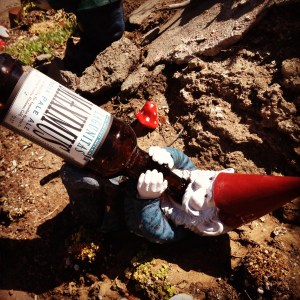 Quite a year we just had. A year that drove that poor little garden gnome in the photo on the right to drink, not to mention me with my cabinet full of gin. So many poems feel like possibilities to greet the new year, but this one by Langston Hughes feels the most possible. It’s strange, because if asked I would never list Langston Hughes on my Favorite Poet list, but lines from his poems come drifting through my mind almost every day. Like this one: Hold fast to dreams, for if dreams go, life is a barren field frozen with snow. And this one: They’ll see how beautiful I am and be ashamed– I, too, am America. And this one: I’ve known rivers: Ancient, dusky rivers. My soul has grown deep like the rivers. And most of all, I see that my own hands can make the world that’s in my mind. Goodbye, 2016. Here’s to the baby new year.
 ollege, and how when I make coffee for her she sits quietly at the kitchen table, her head slightly bowed, silent, because she’s not a morning person, and how her black hair shines in the lamplight. Then I pictured the other daughter, who lives in Boston and whose room still smells like her, and I resisted the urge to get up and walk across the hall and open the door to her so I could breathe her in. Then I pictured the son who lives in Chicago and I remembered the collection of duct tape + cardboard swords he made when he was a little boy. And the other people I most love –the best friend, the painter, the sisters and brother and parents and friends– gathered together in my mind in the dark. All this is to say that when I read the poem below, it feels exactly like those middle of the night thoughts – that everything that matters is small and specific and enormous at the same time.
 Young woman across the street, waving and calling to me as I trudge through the snowdrifts on the way home from
  I’ve been teaching a few free creative writing workshops in various Minneapolis neighborhoods over the last week. It’s a small thing, but it’s something that I can do. In one of the workshops yesterday, fourteen participants sat around a big conference table at a library, each with a name sign propped in front of their notebook. They wrote about someone they knew very well, and then they wrote about a moment in their past, and then they jumped off the fictional cliff and wrote a scene between a conjured person and a conjured object. Everyone read everything they wrote out loud, and we clapped after each reading. Why? Because each reading was beautiful, or funny, or hauntingly sad, or made us catch our breaths in some unexplainable way. In the room was an older gentleman with cerebral palsy; an E.R. nurse from Somalia; a middle-aged man with his young wife, who was in the later stages of early-onset Alzheimer’s and whose three writings were each about her love for her husband; a military veteran; a trans activist; a born-again former felon; a burkha-wearing mother of three; a million-dollar realtor, and more. Everything that the world needs to be better was in that room yesterday, among those disparate people: the willingness to share, the willingness to listen, and the willingness to imagine. Don’t ever tell me we can’t get along. Don’t ever tell me we can’t be generous with each other. Don’t ever tell me we can’t celebrate someone whose life is fundamentally different from ours. I have seen with my own eyes in hundreds of classrooms over dozens of years that Yes, we can.
 I was born too late to be a hippie and I grew up in the rural north, not exactly the site of mass protests and marches in the streets (we had hardly any streets). But I remember being a little girl and sitting in the high school cafeteria before elementary school started (my mother was a high school teacher and we sometimes rode to town with her to avoid the school bus horror show) observing the gigantic and intimidating high schoolers and wondering what the black armbands on some of their arms meant. It isn’t easy to give up hope, to escape a dream, says Dorianne Laux in this haunting poem. Nor should it be.
 Once, at a magic show held at night in a converted barn in rural New Hampshire, I watched a girl gasp in amazement as a happy young man in a cape pulled a rabbit from a hat, and then –somehow– made a bird in a cage disappear from the stage and reappear at the back of the room. Did you see that? the girl said to me. That was amazing. She was fifteen at the time, and I remember thinking how beautiful it was that she could still be captivated by magic. Some years later, from her first job, a year spent at the poorest elementary school in the poorest neighborhood of a big city, a job which taxed her spirit to the limit because of the nearly unimaginable suffering her students lived under, she sent me a text. It was “Atten-Dance” day for the fourth-graders, a day on which all the students with good attendance got to stay after school for a dance put on for them by the girl and her colleagues. This is the best day of the year, her text said. My babies —which is what she, at 22, called her students– are so excited. They’re jumping around like the little kids they for once get to be. Like the poem below says, we can make this place beautiful. Even now.

