Never Coming Back(story) #1
 How well can we ever really know one another?
Faulkner’s famous, ferocious question has been with me throughout my life. It was one of the guiding lights behind my new novel Never Coming Back (out on October 10), a book about the relationship between two people –Tamar Winter and her daughter Clara– who, despite their profound love for each other, have never been able to talk about the secrets they hold in their hearts. But now Tamar has early-onset Alzheimer’s, and time is running out.
Never Coming Back wrote itself in a compulsive rush. Questions tumbled out across the pages, fierce questions that I have spent my own life asking myself. Why do we so often hide so much from the people closest to us? Why, much of the time, do we assume that there will always be more time? Why, for so many of us, is it only at the end of life that we spill our secrets, desperately seeking to close the distance between ourselves and the people we most love?
As I wrote the book I made a silent vow, not for the first time in my life, to talk, truly talk, with the people closest to me. To make sure they know how much I love them. That feels easy. But what about the regrets I have? What about the things I wish I’d done or could undo in my life? What about the conversations I didn’t have when I still had the chance, when some of the people now gone from the earth, people I loved with all my heart, were still alive?
These questions were troubling through me again a few days ago while hiking. You can’t go back in time, Alison, was the answer that kept coming to me, the same answer that has always come to me. Because it’s true, right? You can’t.
Then another thought came floating in, which was that I can do anything I want if I disregard the time-space continuum. I can talk to my lost loved ones as if they were still alive. I can go back in time, even if only in my own mind, and re-do conversations and actions the way I wish I had the first time.
In Never Coming Back, Tamar and her daughter Clara know that time is not on their side. They struggle and stumble toward reconciliation, resolution, and clarity. As I wrote the book I struggled and stumbled along with them. I watched from the sidelines as they tried and tried again. I love these two women as if they have been part of my life since birth. Maybe they have.
Reviews so far have been good.
“[A] quietly powerful novel….fans will appreciate McGhee’s magnetic prose and her ability to pack a richly detailed story into a slim novel. Atmospheric and introspective.”—Booklist
“A luminous novel….the author’s gift for subtly poetic language and her believable dialogue make Clara’s journey worth following. McGhee has an almost musical ability to repeat the themes of her novel with enough variation to keep them fresh. Fierce, complicated characters appear to grow out of the severe Adirondack landscape, and McGhee swerves away from sentimentality in addressing the relentlessly changing relationship at the novel’s core.” —Kirkus Reviews
“[A] poignant meditation on the relationship between a mother and daughter….Though this well-written story will appeal to a broad range of readers for its rich characterization, mothers and daughters will especially find Clara’s and Tamar’s story moving and memorable.”—Publishers Weekly
“Never Coming Back is a deeply moving exploration of growing up and growing old, and the ties that bind parents and children – and the mysteries that sometimes keep us apart.”—Chris Bohjalian, bestselling author of The Sleepwalker, Midwives, and The Sandcastle Girls
“A wise, humane book and a very special novelist.”—George Hodgman, New York Times bestselling author of Bettyville
“Alison McGhee returns to the landscape of the Adirondacks in this beautifully devastating novel about the things that remain unspoken between parent and child. Never Coming Back is an exquisite book, brim-full with nostalgia, love, regret, humor, yearning–and unforgettable prose.”—Julie Schumacher, author of Dear Committee Members
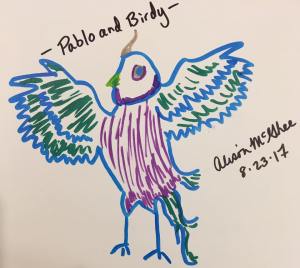 Hurricanes and earthquakes and floods and the ongoing human cruelty inflicted by our elected employees against their fellow human beings. Jeez. It’s enough to make me understand (a tiny bit, anyway) why religious people start tossing around terms like “the end times.” Screw that, though. Enough good people determined to make the world better will do just that. Let us be like the whales in this strange and unforgettable poem by Albert Goldbarth, and sing to each other.
 What sticks with me about this tiny story, more than anything, is the fact that when she told it to me, my grandmother used the term “slavery” with regard to her grandfather. As a child, I thought slavery was confined to the U.S., the great and irredeemable horror and shame of white people owning black people. But according to my grandmother, there were slaves in Denmark, white slaves, and my great-great-grandfather was one of them.
 People look at me with confusion when I tell them I’m deeply wary of charismatic people, with charisma defined in the broad sense as “a personal magic of leadership arousing special popular loyalty or enthusiasm for a public figure (such as a political leader).” But wait, isn’t charisma charming, magnetic, powerful? Sometimes. And sometimes it’s a mask for manipulation, a bottomless need for adulation, attention, look at me look at me look at me, take care of me and do as I say because I am more important than you. Charismatic people so often go unchecked, no matter their behavior, because a) people are drawn to them by that magnetic personality and b) charismatic people often snap at anyone who calls them out on their behavior, in a vicious, malevolent and wildly cruel way.
 The other day a new friend walked into my house and stopped to look at some photos perched on a bookcase. “Is that you?” he said, pointing to one of a girl on a windsurfer. “No, that’s my daughter,” I said, admiring her, how the wind was blowing her long hair back. Then time did one of its weird pivots and I startled and sort of laugh/winced, because why had I said the girl on the windsurfer was my daughter? She wasn’t. She was me, long ago, when I was the age that my daughter is now.
 “Hi, this is Alison McGhee, patriotic citizen, calling from 55408.” Ever since the atrocity, which is my term for what went down last November, I make calls or send emails every day. I march if there’s a march. Taking action is the one thing that keeps me from sinking into a kind of paralyzed despair at both the crumbling of democracy I see all around me and the cruelty that is being encouraged and applauded.


