Poem of the Week, by Martin Espada
 One of the top-rated MFA programs in the country once recruited me to fly out and interview for a fiction position. A day into the interview, deep in discussion of teaching technique with the faculty and students, I subtly began to portray myself as less interested in criticism and more interested in nurturing a creative spark. This wasn’t what they wanted in a teacher and I knew it. I was in effect throwing the interview, but I wasn’t sure why.
Years later, I do. In the midst of the enormous talent gathered in that interview room, I wanted to be back with my students. My immigrant, refugee, loan-burdened, first in their family to go to college, work two jobs and raise a family and still make it to class students. Listening as they read their work aloud, then clapping for their gargantuan effort. Seeing a poem they wrote make their classmates cry. When news broke last week of the college-admission bribery scandal, this stunning poem by Martin Espada instantly came to mind, and I thought of my students, their hands upturned and burning.
Who Burns for the Perfection of Paper
by Martin Espada
At sixteen, I worked after high school hours
at a printing plant
that manufactured legal pads:
Yellow paper
stacked seven feet high
and leaning
as I slipped cardboard
between the pages,
then brushed red glue
up and down the stack.
No gloves: fingertips required
for the perfection of paper,
smoothing the exact rectangle.
Sluggish by 9 PM, the hands
would slide along suddenly sharp paper,
and gather slits thinner than the crevices
of the skin, hidden.
The glue would sting,
hands oozing
till both palms burned
at the punch clock.
Ten years later, in law school,
I knew that every legal pad
was glued with the sting of hidden cuts,
that every open law book
was a pair of hands
upturned and burning.
For more information on Martin Espada, please check out his website.
 A few days ago at sunset the sky was unearthly. The Painter came home, grabbed his camera and tripod and headed to the beach to take a bunch of photos. My internal, unspoken take on this, having never seen him take a sunset photo before: You had a frustrating day in the studio. Nothing was working with your paintings. You feel blocked, so you’re trying something new, to change up the energy and get things moving again.
  My daughter at eight: What would happen if you die? I tell her she would be very sad but everyone would take such good care of her, and she says No, they wouldn’t. Because I would be dead too, of sadness. My son at four shuffles out of the bedroom in his first pair of flip-flops, having put them on himself with the strap between his second and third toes. It’s fine, mama, don’t worry, they don’t hurt, I can walk. My grandmother, flustered and red-faced in the small kitchen where she’s trying to make dinner for me: Oh Alison, I’m just no use at all anymore. Me outwardly protesting but inwardly stricken by the knowledge that in that single instant, everything is now changed.
  My five year old nephew is currently huddled behind closed doors inside his family’s new freestanding pantry, where he fits neatly into the bottom cupboard. I know this because my brother texts me ongoing updates as to this fixation with the pantry, along with the fact that my nephew just declared he’s no longer a ninja genius but a secret agent. (Didn’t surprise me at all. I never bought the ninja genius line.) My nephew cracks me up and breaks my heart the way all little kids, over and over, break my heart.
  In the lobby of the Minnesota Public Radio headquarters are three white egg-shaped chairs. Whenever I’m there I crawl into one of them, sit cross-legged, and close my eyes. Sitting in one is like wearing a warm sweatshirt with the hood pulled entirely over your head. My love for those chairs is inordinate. When I picture a safe place to comfort myself when sad or troubled, those egg-shaped chairs come to mind.
  A few years ago a lifelong minor heart glitch spiraled out of control. I didn’t tell anyone until a couple hours before the surgery to fix it, so as not to worry them, and I took a Lyft to the hospital. But just before the procedure, as the surgical team was pushing the gurney into the OR, I put my hand on the arm of the nearest blue-masked nurse. Please take good care of me, I said. I don’t want to die.
 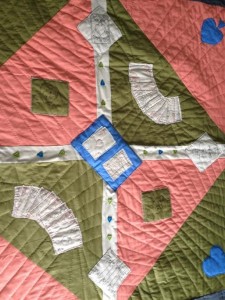 The day after I moved to Minneapolis, I bought a sewing machine. This was in the days of newspaper ads, and I found a used one for $60 and insisted my then-boyfriend and I track it down that very day. That ancient, impossibly heavy machine is what I’ve used to make all the quilts I’ve ever made, sewing together blocks I hand-stitch piecemeal. Story quilts, every one of them, made not according to a pattern but out of my head and heart.
  Someone close to me sent me a booklet a while ago, photos and written memories of her life. It’s a fascinating glimpse into a childhood spent solo with older parents in upper Manhattan, a gentle childhood filled not with money, of which there was very little, but with family card games, shared meals, trips to museums and playgrounds, school days and summer camp upstate. Black and white photos show a small, smiling girl in the embrace of a mother and father who clearly adored her. Here they are leaning against a railing by Rockaway Beach. Here they are on the stoop of an apartment building. Here’s the little girl on the first day of school.
 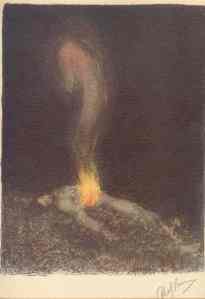 This body of mine. These bodies of ours. As a girl I often witnessed both my friends and older women close to me disparage their bodies. One of my grandmothers had been a model in her youth, and she despised photos of her aged self so much that I couldn’t let them near her – she would snatch them and tear them up. My other grandmother openly hated her heavy legs, had hated them her whole life long. In response to this self-hatred, which was so painful to see, I early on vowed never to say one bad word about my body to anyone, especially my daughters. This is a vow I kept. But still. This body of mine. This body that will do everything in its power to keep me alive until my last breath. Oh my body, I have not always loved you the way you deserve to be loved. Fearfully and wonderfully made body, I have not always been good to you. When I heard this poem, I wept.
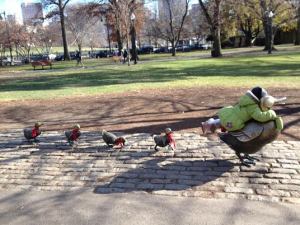 My three children and I were in upstate New York. This was a long time ago, and we were making our annual summer trek around New England to visit family and friends. We had just finished touring the Utica Club Brewery, one of my favorite childhood destinations, a tour that ends with a complimentary beer or root beer in a Victorian saloon. We were all tired. I was chatting with my parents while my children wandered around, trying out various red velvet chairs.
 Alison McGhee