Would you like to start the new year with an hour each morning of quiet writing in the company of others, without the pressure of sharing or feedback? Please join us for Write Together, January 12-17. Each day’s Zoom session features different readings, different prompts, and the chance to write quietly together in solidarity and appreciation. $100, with one scholarship remaining. Click here for more information and to sign up.
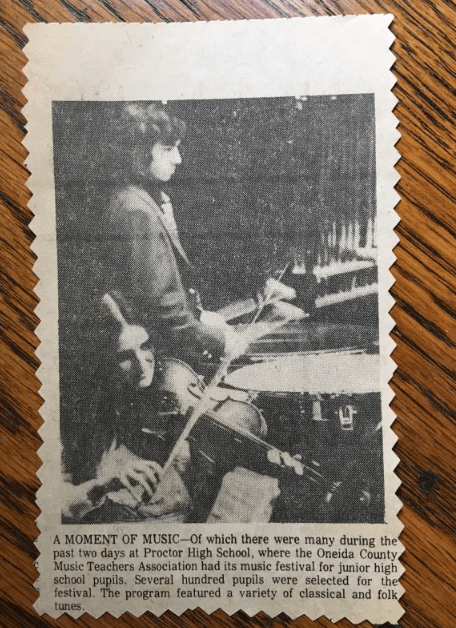
The violinist with the beautiful smile in this photo used to be one of my closest friends. She lived in a small bright green ranch house right across the street from the middle school, and we would sneak out of school at lunchtime and go there to drink chocolate milk and eat peanut butter sandwiches.
Her sisters and brothers were in high school, unimaginably older and cool, laughing and talking and making offhand jokes about things like sex and drugs and rock ‘n roll. Had I been alone I would have been stunned and cowed and half-paralyzed by their coolness, their easy laughter. But I wasn’t alone. I was with her.
Why did she like me? In retrospect I was a quiet observer and not much fun back then, although maybe I’m not the best judge of that. But one reason she liked me is easy: she liked nearly everyone. She had a huge and generous heart. She was also unafraid of things that I was afraid of, like saying out loud that which scared me, hurt me, made me angry. She was honest about things. She saw life clearly, and stating the obvious didn’t scare her.
The boy I had a crush on used to ask if he could have a punch off my lunch ticket. Sure, I would say. I’ll pay you back, he would say. He’d run across the grass, back into the school. He won’t, you know, she observed. He won’t pay you back. And you’ll give it to him tomorrow if he asks. I looked at her. She looked back at me and smiled. She was wise. She was honest. She stated things the way they were. And she was unjudging. She was one of those rarest of creatures, a human being completely comfortable in her own skin.
She died of an aneurysm almost thirty years ago now, but I think of her most every day. That dark hair, those blue blue eyes, that grin. On the rare occasions when I drink chocolate milk, I make a mental toast to her. In my memory she is always smiling. A big, merry smile that showed off her high cheekbones. When I think of her, I also think of this poem.
My Dead Friends, by Marie Howe
I have begun,
when I’m weary and can’t decide an answer to a bewildering question
to ask my dead friends for their opinion
and the answer is often immediate and clear.
Should I take the job? Move to the city? Should I try to conceive a child
in my middle age?
They stand in unison shaking their heads and smiling—whatever leads
to joy, they always answer,
to more life and less worry. I look into the vase where Billy’s ashes were —
it’s green in there, a green vase,
and I ask Billy if I should return the difficult phone call, and he says, yes.
Billy’s already gone through the frightening door,
whatever he says I’ll do.
Click here for more information about Marie Howe. Today’s poem first appeared in What the Living Do, published in 1998 by W.W. Norton & Company.
alisonmcghee.com
My podcast: Words by Winter
 Alison McGhee
Whatever leads to joy sounds easy, but isn’t.
But when I hear from those who have “already gone through the frightening door” I sit up and listen. And I’m beginning to hear my Mom’s voice more and more as I speak. I don’t even ask for her opinion. She hard-wire it in.
LikeLiked by 1 person
Dang, Robin. I love that your mother’s voice and opinions are just hard-wired in. So cool.
LikeLike
Wonderful story and a wonderful poem Alison. You are a great teller of stories!
>
LikeLike